Seated Liberty Coins: A Complete Guide to Values and Key Dates
The Seated Liberty series (1836–1891) is one of the most ambitious in American numismatic history: a single goddess design adapted to six silver denominations over more than half a century. Coins range from common circulated dimes worth $20–$50 to legendary rarities worth six figures. Whether you are assembling a type set, chasing key dates, or trying to sell inherited examples, this guide covers what Seated Liberty coins are worth and what to watch for when buying or selling.
Key takeaways
- The Seated Liberty design appeared on six U.S. silver denominations from 1836 to 1891 — the longest-lived coin design of the 19th century.
- All Seated Liberty coins are 90% silver; melt value ranges from roughly $3 (half dime) to $8 (half dollar) at mid-2020s silver prices.
- Common circulated dimes sell for $20–$50; common half dollars and dollars bring $50–$250 in well-circulated grades.
- The 1870-S dollar may be unique; the 1873-CC dime and 1838-O half dollar are legendary rarities.
- Cleaning is rampant in this series — buying certified coins protects you on anything priced over $100.
What Is the Seated Liberty Design?
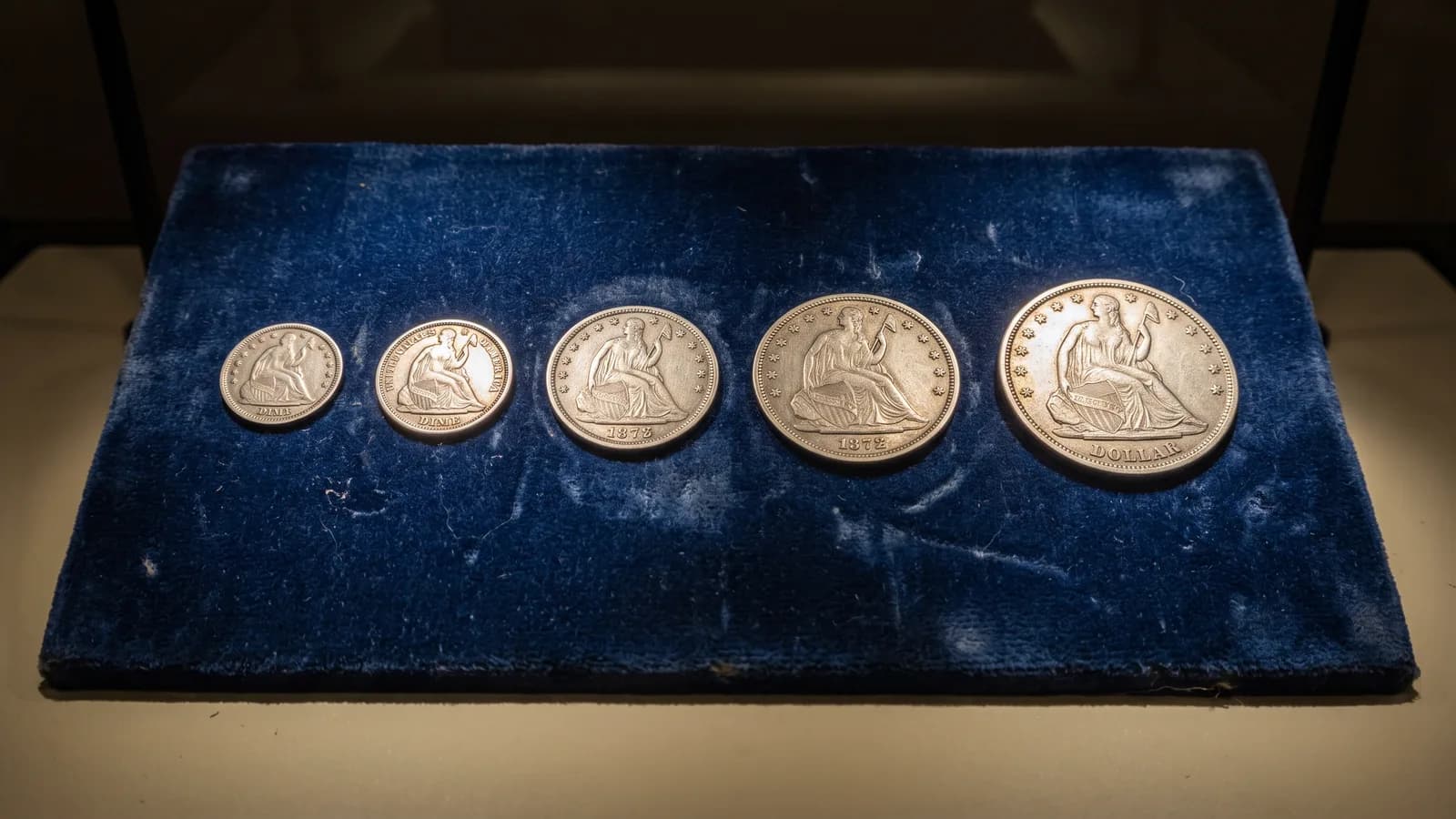
Christian Gobrecht, the U.S. Mint's chief engraver, created the Seated Liberty design: Liberty seated on a rock, holding a shield inscribed "LIBERTY" in her left hand and a pole topped by a Liberty cap in her right. The design appeared first on the dollar in 1836 and spread to all silver denominations by 1839.
The design's longevity — 55 years — makes it both a unifying series for collectors and a challenging one, since six denominations across dozens of mint facilities produced thousands of date-and-mintmark combinations. Mastering the series rewards systematic study.
Which Denominations Carried the Seated Liberty Design?
Six denominations bore the Seated Liberty obverse: the half dime (1837–1873), dime (1837–1891), twenty-cent piece (1875–1878), quarter dollar (1838–1891), half dollar (1839–1891), and silver dollar (1840–1873). Each denomination has its own mintmark history, die varieties, and key dates — though the shared design links them as a coherent collecting series.
The twenty-cent piece is technically a separate series, struck only four years (1875–1878), but uses the same Gobrecht-inspired obverse and is commonly included in Seated Liberty type sets.
No-Motto vs. With-Motto: What the Design Changes Mean
Congress authorized "IN GOD WE TRUST" on U.S. coins in 1866, following the Civil War. Seated Liberty coins struck before 1866 carry no motto ("No Motto" type); those from 1866 onward display it on the reverse. The motto addition is significant for collectors: No Motto coins of the same date are often struck in smaller quantities and can command premiums in high grades.
On quarters and half dollars, 1853 is another pivotal year: arrows were added to the date and a sunburst/rays appeared on the reverse to indicate a reduction in authorized weight. These "Arrows and Rays" varieties are one-year types for the rays. The arrows remained through 1854. Similar arrow-at-date changes occurred in 1873.
What Are Common-Date Seated Liberty Coins Worth?
Common-date half dimes and dimes in G-4 to F-12 condition sell for $20–$50. Quarters in the same range run $25–$65. Half dollars in circulated grades typically bring $40–$100. Dollars in G-4 start around $150–$250 for common Philadelphia dates. At current silver prices (roughly $30–$35 per troy ounce as of mid-2025), melt value for a half dollar is approximately $7–$8, but numismatic value far exceeds melt on nearly every date.
Use our silver melt calculator to get today's exact melt figure for any denomination. Remember: the coin's numismatic premium — especially for scarcer dates and higher grades — almost always dominates.
Key Dates in the Half Dime and Dime Series
Among half dimes, the 1844 has a very low mintage and is scarce in any circulated grade; New Orleans issues of the early 1840s are similarly tight. The 1870-S half dime may be unique — it reportedly was not supposed to be released and was discovered only decades later. Among dimes, the 1873-CC No Arrows is among the rarest of all U.S. 19th-century silver coins, with fewer than fifteen known. The 1894-S Barber dime (a different series, though sometimes confused with Seated) is in a similar rarity class.
For most collectors, the half dime and dime series are approachable. Common dates in Fine to Very Fine condition are plentiful and inexpensive. The challenge is condition — problem-free examples in EF or better are far scarcer than raw population numbers suggest.
Key Dates in the Quarter and Half Dollar Series
The 1842-O quarter small date is a major rarity — most Philadelphia 1842s have the large date; an 1842-O small date is extremely scarce. Among quarters, the first-year 1838 issue and early New Orleans coins of the 1840s are genuinely scarce in grades above Fine.
In the half dollar series, the 1838-O is the key rarity, with fewer than ten known. Early New Orleans issues of the 1840s have low mintages. The 1853-O No Arrows and Rays half dollar is extremely rare, as virtually all 1853 O-mint halves carry the Arrows and Rays. In Very Fine and above, key half dollars are serious six-figure coins.
Key Dates in the Silver Dollar Series
The Seated Liberty dollar (1840–1873) has several important rarities. The 1870-S reportedly exists as only one or two examples — one is in the Smithsonian and another may be in private hands. The 1851 and 1852 were struck almost entirely as proofs; genuine business strikes of those dates are extremely rare. The 1873-CC With Arrows is scarce, with a relatively low surviving population.
Common New Orleans and Philadelphia dollars from the late 1850s through 1860s are available in Fine for $150–$300 and are the typical entry point for collectors building a circulated type set.
Die Varieties: Overdates, Repunched Mintmarks, and Doubled Dies
The Seated Liberty series is exceptionally rich in die varieties: overdates (one date punched over another), repunched mintmarks, and doubled dies are documented across most denominations. The American Numismatic Association (ANA) and specialist references document hundreds of varieties. Identifying one can add a 2–5× premium over the plain date's value.
Variety collecting in this series rewards patience and a good loupe. The most commonly sought varieties include numerous overdates in the dime and half dollar series, and the 1853/2 and 1858/7 overdates in the quarter.
The Cleaning Problem: Why It Matters So Much
A large proportion of Seated Liberty coins encountered in the wild have been cleaned, dipped, or polished at some point in their 130–180 year lives. Cleaning removes the original luster and toning that give a coin its numismatic appeal. A bright, gleaming Seated Liberty half dollar is almost always a red flag — original 150-year-old silver should be dull gray or lightly toned, not mirror-bright.
Buy certified coins from PCGS or NGC for anything over $100. Both services flag cleaned and problem coins with a "Details" grade designation, which is immediately reflected in price. An EF Details coin is worth substantially less than a straight-graded EF.
How to Buy Seated Liberty Coins Wisely
For circulated coins under $50, buy in-person at a coin show or from a trusted local coin dealer who will let you examine the coin in hand. Look for dull, original-looking surfaces, well-struck devices, and no signs of scraping or polishing. For anything over $100, buy certified.
When building a type set, start with the most common denominations and dates to learn what problem-free coins look like before spending more on key dates. A modest circulated type set of all six Seated Liberty denominations in F-VF condition is achievable for $500–$1,500.
Selling Seated Liberty Coins
PCGS- and NGC-slabbed examples sell best at major auction houses (Heritage Auctions, Stack's Bowers, Great Collections). Buyers pay full retail at auction because grade and authenticity are guaranteed. Raw circulated coins in common dates are best sold to a local dealer or at a coin show, where buyers can see them in hand.
Expect the dealer bid on raw circulated common dates to be 20–40% below current retail. Key dates and high-grade certified coins fetch considerably closer to auction retail. Get an independent appraisal from a numismatic appraiser before selling any coin you believe might be a key date.
Starting a Seated Liberty Type Set
A type set — one example from each denomination and major design type — is the most popular approach. The minimum type set for Seated Liberty covers the half dime, dime, quarter, half dollar, and dollar in circulated grades, giving you five or six coins that tell the full story of the series. Adding the twenty-cent piece completes the picture.
Allocate more budget for the dollar (which starts higher even in common dates) and less for the half dime and dime. A well-chosen Fine-to-Very Fine circulated type set across all denominations is achievable for $600–$1,500, excluding the silver dollar if you prefer. See our guide to coin grading to understand the grade ranges that give the best value.
Frequently asked questions
Are all Seated Liberty coins made of silver?+
Yes. All Seated Liberty dimes, quarters, half dollars, and dollars are 90% silver (.900 fine). The half dime is also 90% silver. The twenty-cent piece is 90% silver as well.
What is the rarest Seated Liberty coin?+
The 1870-S dollar may be unique or nearly so. The 1838-O half dollar (fewer than ten known) and the 1873-CC No Arrows dime (fewer than fifteen known) are also legendary rarities worth six figures each in any condition.
Why do some Seated Liberty coins have arrows beside the date?+
Arrows flanking the date indicate a change in the coin's authorized weight — added in 1853 (weight reduced) and 1873 (minor metric adjustment). They are design-change markers that create distinct collectible varieties.
How do I know if my Seated Liberty coin has been cleaned?+
Original silver coins from this era will be dull, gray, or lightly toned. Bright, shiny silver on a 150-year-old coin almost always signals polishing or chemical dipping, which significantly reduces numismatic value.
Should I get my Seated Liberty coins graded?+
For any coin worth more than $100 — which includes most mid-grade or better examples — PCGS or NGC certification is worth the cost. It protects you when buying and dramatically eases selling.
Can I sell Seated Liberty coins to a local coin shop?+
Yes, and for common circulated dates it is often the fastest path. Expect the dealer to offer 50–70% of retail for raw common dates, more for certified key dates. Get multiple bids for anything unusual.