
Proof vs. Uncirculated Coins: What the Difference Means for Value
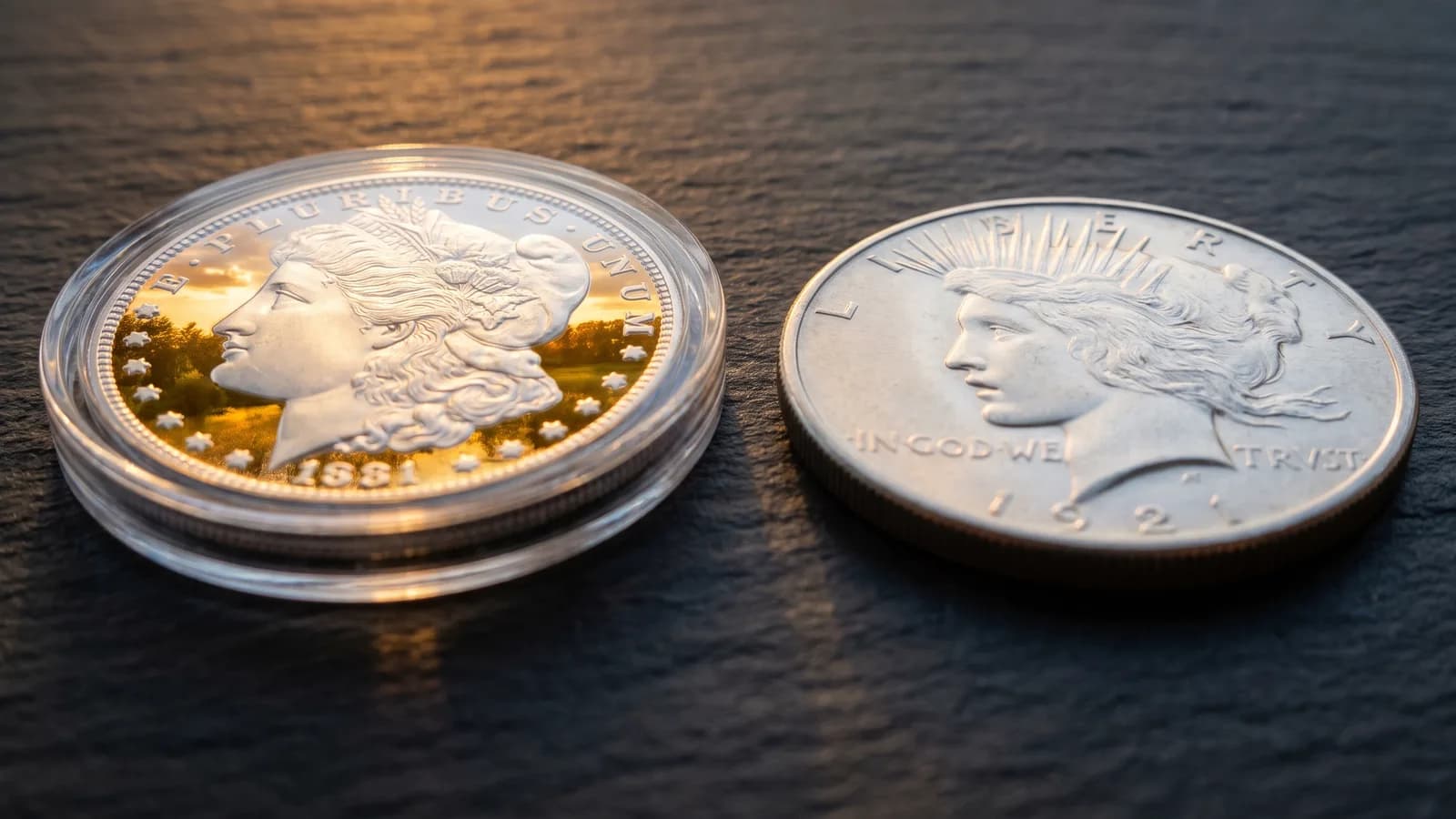
"Proof" is one of the most misunderstood terms in coin collecting. It refers to a method of manufacture, not a grade or condition. A proof coin is struck on a specially prepared, polished planchet using highly polished dies, producing mirror-bright fields (the flat areas) and frosted, sculpted devices (the raised design elements). An uncirculated business-strike coin, by contrast, has satiny luster created by the contact between a standard die and a standard planchet. Understanding the difference — and when it matters for value — is essential for any collector.
Key takeaways
- Proof coins are struck on specially prepared planchets with polished dies, producing mirror-bright fields and frosted ("cameo") devices.
- Uncirculated (Mint State) business-strike coins have satiny cartwheel luster — different from proof but equally desirable at high grades.
- Proof grades run from PF-60 to PF-70; Mint State grades run MS-60 to MS-70. Both use the Sheldon 70-point scale.
- Deep Cameo (DCAM for PCGS) or Ultra Cameo (for NGC) is the most desirable contrast on proof coins and commands the highest premiums.
- For most series, proofs are worth more than business strikes of the same date — but not always, especially in early American coinage.
What Makes a Proof Coin a Proof?
A proof coin is the product of a specialized minting process: the planchet (blank) is polished to a mirror finish before striking, and highly polished dies are used to transfer the design. The coin is typically struck more than once to bring up all design detail fully. The result is a coin with mirror-like fields and frosted, sculpted devices that create a striking visual contrast.
Proof coins are made specifically for collectors, not for circulation. They are sold by mints directly to collectors in special packaging. Modern U.S. proof coins from the San Francisco Mint (S mintmark) are the most familiar example.
Cameo and Deep Cameo: The Most Sought-After Proof Finish
As proof dies are used repeatedly, the frosting on the devices gradually wears away. Early strikes from a fresh die show the most dramatic contrast between mirrored fields and frosted devices — this is called Cameo contrast. The deepest, most dramatic contrast is called Deep Cameo (DCAM) by PCGS or Ultra Cameo by NGC.
A proof coin graded PF-68 DCAM is worth substantially more than the same coin graded PF-68 without the Cameo designation. For many modern proof series, Cameo and Deep Cameo coins are the only ones collectors actively seek, making the designation as important as the numerical grade.
What Is an Uncirculated (Mint State) Coin?
An uncirculated coin is a business-strike coin that has never circulated — it was struck for commerce but went directly into collector hands or storage without being spent. Its surface is not proof-like; instead, it has the satiny, flowing luster created by the normal minting process.
Business-strike coins are graded on the MS-60 to MS-70 scale (Mint State). MS-70 is theoretically perfect; MS-65 is considered gem quality; MS-63 is commonly available Mint State. A well-struck MS-65 business-strike Morgan dollar and a PF-65 proof Morgan dollar of the same date are different products with different values — and neither is inherently more valuable than the other.
Proof Grading: PF-60 Through PF-70
Proof coins use the same Sheldon numerical scale as business strikes, but graded as PF (proof) rather than MS (Mint State). The evaluation criteria include the depth of the mirror fields, the sharpness of the frosted devices, and the number and severity of contact marks or hairlines (tiny scratches from mishandling during or after production).
Hairlines in the mirror fields are the enemy of high-grade proofs. Even gentle wiping with a cloth can leave hairlines visible in a proof's mirror finish. A proof with heavy hairlines might grade PF-60 or PF-61, worth little premium. A flawless PF-70 is worth many times more than a PF-68 of the same coin.
When Are Proofs Worth More Than Business Strikes?
For most modern series (post-1955), proof coins are worth more than business-strike uncirculated coins because they were produced in limited quantities and sold at a premium. For 19th-century series, the relationship is more complex — proofs of some dates were made in tiny numbers (50–200 pieces) and are extremely rare, while business strikes ran into the millions.
There are cases where business strikes are worth more than proofs. For some early U.S. coins (large cents, early silver), a gem Mint State business strike is far rarer than a proof of the same date — because MS survivors are almost nonexistent while proofs were carefully preserved. The value relationship depends entirely on the specific coin and date.
Should You Collect Proofs or Business Strikes?
The choice comes down to what appeals to you aesthetically and what fits your budget. Proof sets are a natural way to collect modern U.S. coinage — the annual proof sets from the San Francisco Mint cover all denominations in a clean presentation case. Business strikes require more active searching for high-grade examples but can offer better value for numismatic content.
Many collectors build both — a circulated set for date completion and certified high-grade examples (proof or business strike) for the coins they love most. Ask a local coin dealer to show you examples of both finishes side-by-side — the visual difference is immediately apparent.
Frequently asked questions
Does proof mean the coin is perfect or very high grade?+
No. "Proof" refers to the minting method, not the condition. A proof coin can be scratched, spotted, or damaged and grade as low as PF-60. A PF-70 proof is essentially perfect; a PF-60 has significant marks.
What is a "specimen" or "SP" coin?+
Specimen coins (graded SP by PCGS and NGC) are struck with more care than business strikes but less precision than proofs — they have semi-reflective or satiny fields rather than full mirror surfaces. Early U.S. coins sometimes called "proofs" are often reclassified as specimens today.
Are proof coins struck for circulation?+
No. Modern proof coins are sold directly to collectors and are never intended to circulate. However, proof coins occasionally do enter circulation (through careless handling, estate dispersal, etc.) and circulated proofs exist.
Why do some proofs have hairlines?+
Hairlines are tiny scratches, often from wiping or sliding coins across a surface. The mirror finish of a proof is exquisitely sensitive to contact — hairlines visible only at certain angles can drop a proof from PF-68 to PF-63 or lower. Always handle proofs by the edge.
What is a "reverse proof"?+
A reverse proof inverts the standard finish — the fields are frosted and the devices are mirrored. The U.S. Mint has issued reverse proofs for special occasions (e.g., the 2011 American Silver Eagle 25th Anniversary set). They are popular collector items and command premiums over standard proofs.