
Saint-Gaudens Double Eagle: America's Most Beautiful Coin
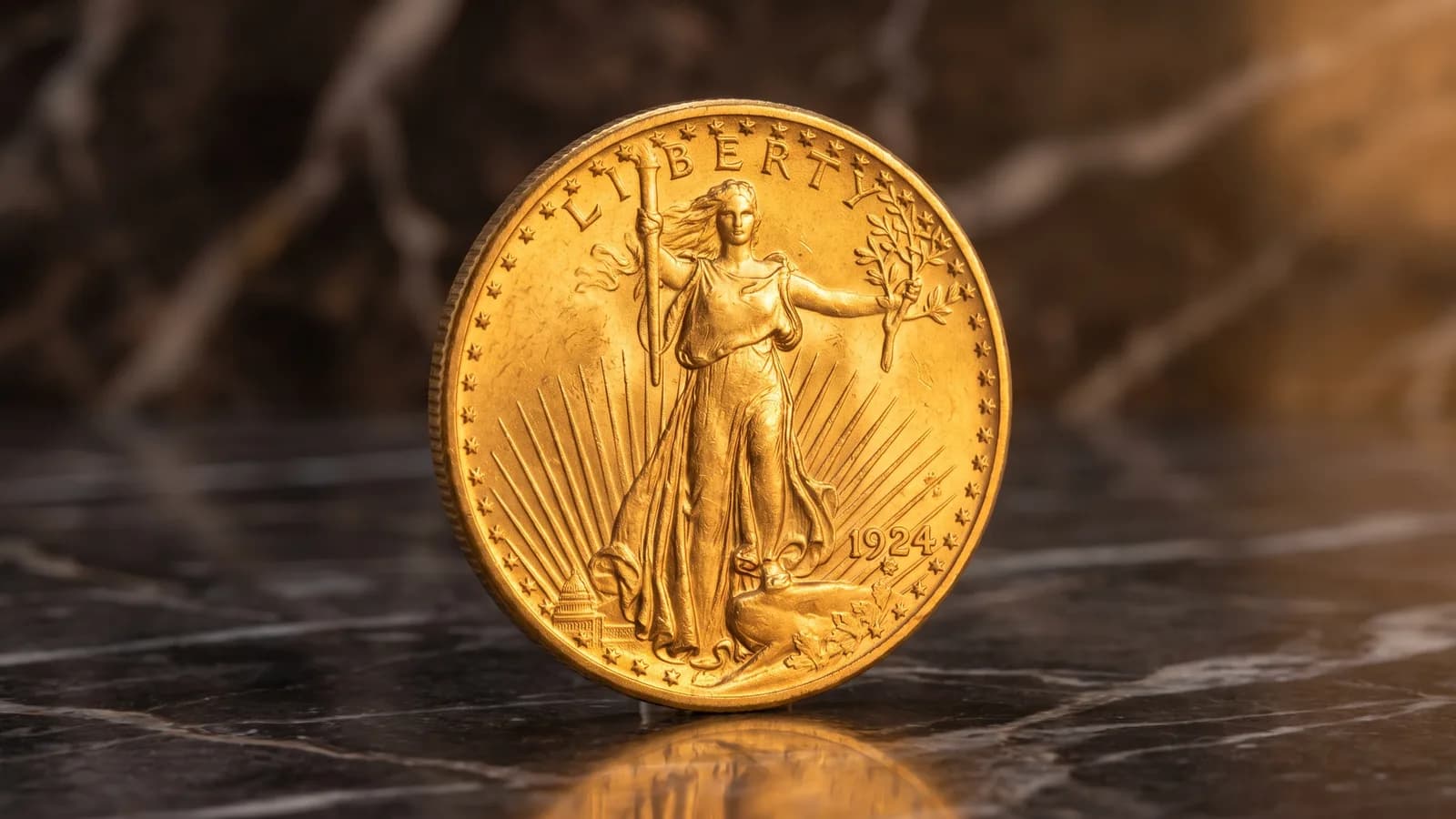
The Saint-Gaudens double eagle is widely considered the most beautiful coin ever struck by the United States Mint. Commissioned by President Theodore Roosevelt, who wanted U.S. coinage to rival the artistry of ancient Greek coins, the design features a striding Liberty on the obverse and a soaring eagle on the reverse — a dramatic departure from the mechanical portrait coins of the era. Struck from 1907 to 1933, it contains 0.9677 troy ounces of gold. Common circulated dates trade close to gold melt value, while key dates and the legendary 1933 are among the most valuable coins in the world.
Key takeaways
- The Saint-Gaudens double eagle ($20 face value, 1907–1933) contains 0.9677 troy ounces of gold at 90% fineness.
- Common-date circulated examples trade primarily on gold melt value, currently in the $2,800–$3,400+ range depending on spot price.
- The coin was designed by sculptor Augustus Saint-Gaudens at President Theodore Roosevelt's personal request.
- The 1907 High Relief is the rarest business-strike type — fewer than 12,000 were struck and many were melted.
- The 1933 double eagle is the most expensive coin ever sold at auction — a single example sold for $18.872 million in 2021.
The Story Behind the Design
President Theodore Roosevelt found U.S. coinage artistically inferior to ancient Greek coins and commissioned sculptor Augustus Saint-Gaudens — already famous for his public monuments — to redesign the $10 and $20 gold pieces. Saint-Gaudens died in 1907 before seeing his coins struck in their final form, but his design survived largely intact.
The resulting double eagle shows Liberty striding forward, torch raised, against a radiant sun — a dynamic image unlike any previous U.S. coin design. The reverse shows a flying eagle, and the coin's edge carries the motto "E PLURIBUS UNUM" in raised letters. Roosevelt's insistence on omitting "IN GOD WE TRUST" (which he thought sacrilegious on commerce) led to a Congressional backlash that restored the motto in 1908.
Gold Content and Melt Value
Every Saint-Gaudens double eagle contains exactly 0.9677 troy ounces of fine gold. At a gold spot price of $3,000 per troy ounce, melt value is approximately $2,900; at $3,500/oz, it approaches $3,400. Use our gold coin melt calculator to get today's exact figure.
Common circulated examples trade at small premiums over melt — typically $50–$200 above gold value for well-worn pieces, more for better grades. The coin functions simultaneously as a numismatic collectible and a gold bullion vehicle, and its pricing reflects both.
The 1907 High Relief: A Special First-Year Issue
The first Saint-Gaudens double eagles struck in 1907 were in extremely high relief — Saint-Gaudens's original artistic intent — requiring multiple strikes to bring up the design fully. Fewer than 12,000 of these High Relief pieces were struck. Many required three or more blows from the press and did not stack well.
The Mint quickly shifted to a flatter relief for mass production. The 1907 High Relief is now one of the most desirable U.S. gold coins, worth $8,000–$20,000 or more in circulated grades and far more in Mint State. Authentication is essential — counterfeits are made.
Common-Date Values Across the Series
Common-date Saint-Gaudens double eagles (Philadelphia issues from 1908–1932, and common San Francisco and Denver dates) in circulated grades (Very Fine to About Uncirculated) typically sell for gold melt plus a modest premium — $50–$200 above spot for average circulated coins, more in MS-60 and above.
Mint State examples of common dates (MS-62 to MS-65) command premiums of $200–$2,000+ over melt depending on grade. The jump from MS-65 to MS-66 and above can be dramatic. Certified coins by PCGS or NGC in gem grades bring the highest premiums from collectors.
Key Dates in the Saint-Gaudens Series
Beyond the 1907 High Relief, notable key dates include the 1908 No Motto (first year without "IN GOD WE TRUST," before Congress required its restoration), the 1920-S, 1921, and 1927-D — all low-mintage dates with relatively few survivors. The 1929–1932 Philadelphia dates are semi-keys with low circulated survivors, as most were melted following Executive Order 6102 in 1933.
San Francisco and Denver dates vary considerably in rarity. Before purchasing any date above spot price, verify current certified populations and auction records at PCGS CoinFacts or NGC's price guide.
The 1933 Double Eagle: The World's Most Expensive Coin
The 1933 Saint-Gaudens double eagle is in a category by itself. Approximately 445,500 were struck, but President Roosevelt's Executive Order 6102 (April 1933) required all gold coins to be returned to the Federal Reserve — and the Mint melted virtually all of the 1933 double eagles before they were released. Twenty pieces escaped, reportedly through theft, and the U.S. government has spent decades recovering them.
Currently, only one 1933 double eagle is legal for private ownership — the "Farouk coin," which passed through King Farouk of Egypt's collection and was the subject of a government settlement in 2002. That coin sold for $7.59 million in 2002 and, after being graded MS-65 by PCGS, sold again for $18.872 million at Sotheby's in June 2021 — the highest price ever paid for a coin at public auction at that time.
Executive Order 6102 and Pre-1933 Gold
On April 5, 1933, President Franklin D. Roosevelt signed Executive Order 6102, which required U.S. citizens to exchange most gold coins and bullion for paper currency at $20.67 per troy ounce. Most Saint-Gaudens double eagles already in circulation were turned in and melted. Those that survived in collections, overseas, or in bank vaults became the survivors we see today.
Pre-1933 gold coins, including the Saint-Gaudens double eagle, are specifically exempted from reporting requirements on bullion transactions as "rare coins," which makes them popular with privacy-conscious buyers. See our pre-1933 gold coins guide for more context.
No Motto vs. With Motto: Does It Affect Value?
"IN GOD WE TRUST" was omitted from the original 1907–1908 issue at Roosevelt's personal direction, then restored by Congress in 1908. The No Motto coins (1907 High Relief, 1907 Arabic Numeral, and 1908 No Motto) are genuinely scarcer in most grades and carry premiums — but the premium is modest for circulated examples of the 1908 No Motto, which had a substantial mintage.
Collectors building a type set often include one No Motto and one With Motto example. The price difference for common circulated dates is typically a few hundred dollars, making both accessible.
How to Buy a Saint-Gaudens Double Eagle
For common-date circulated examples, any reputable coin dealer who handles bullion can provide a fair price near spot. For key dates or Mint State examples, buy PCGS- or NGC-certified coins — the grade certification protects you and makes resale straightforward.
Avoid uncertified "raw" Saint-Gaudens double eagles sold by private parties or at non-numismatic venues. Counterfeits of the most common dates are well-made enough to fool casual buyers. At gold prices above $3,000/oz, the stakes are too high to skip certification.
Selling a Saint-Gaudens Double Eagle
Common-date circulated examples sell quickly to any local coin dealer or bullion dealer. Expect an offer of 96–99% of spot gold value for well-worn common dates — dealers buy these as bullion. Certified examples in MS-62 and above sell at premiums that most dealers will recognize and pay for.
For key dates, High Relief pieces, or anything unusual, consider major auction houses — Heritage Auctions, Stack's Bowers, and Great Collections regularly sell Saint-Gaudens double eagles to active collector markets. See our guide to selling gold coins for a step-by-step approach.
Frequently asked questions
How much gold is in a Saint-Gaudens double eagle?+
A Saint-Gaudens double eagle contains 0.9677 troy ounces of fine gold. The coin weighs 33.436 grams total at 90% (900/1000) fineness.
What makes the 1933 double eagle so valuable?+
Nearly all 1933 double eagles were melted before release following FDR's gold recall order. Only one is legally owned privately. That coin sold for $18.872 million in 2021 — the highest auction price ever paid for a coin.
Is the Saint-Gaudens double eagle a good investment?+
Common-date examples track gold prices closely, like bullion. Key dates and high grades offer numismatic premium potential on top of gold value. Neither outcome is guaranteed. Consult a [local coin dealer](/coin-shops) for current market context.
Do I need to report buying a Saint-Gaudens double eagle to the IRS?+
Pre-1933 gold coins are generally excluded from the 1099-B reporting thresholds that apply to gold bullion (e.g., Gold Eagle coins in certain quantities). However, capital gains tax may still apply on profits. Consult a tax professional for your situation.
How do I know if my Saint-Gaudens double eagle is authentic?+
Buy certified by PCGS or NGC. If you have an uncertified coin, a reputable coin dealer can check basic indicators, but professional authentication is the only certain answer for a coin worth $3,000+.