
Collectible Tokens: A Guide to Trade Tokens, Transit Tokens, and More
Collectible tokens are privately made metal, wooden, or plastic pieces that look coin-like but were never issued by a national mint as money. They belong to exonumia, the collecting of numismatic items other than government coins and paper money, and they cover a wide family that includes trade tokens, transportation tokens, sales-tax tokens, wooden nickels, love tokens, elongated coins, encased coins, counterstamped coins, and modern military challenge coins. Most are inexpensive, commonly ranging from a few cents to about $20, which is why they turn up so often in inherited collections and junk boxes. This pillar guide explains what each family is, roughly what it is worth, and how to identify, value, buy, sell, and store the pieces you find.
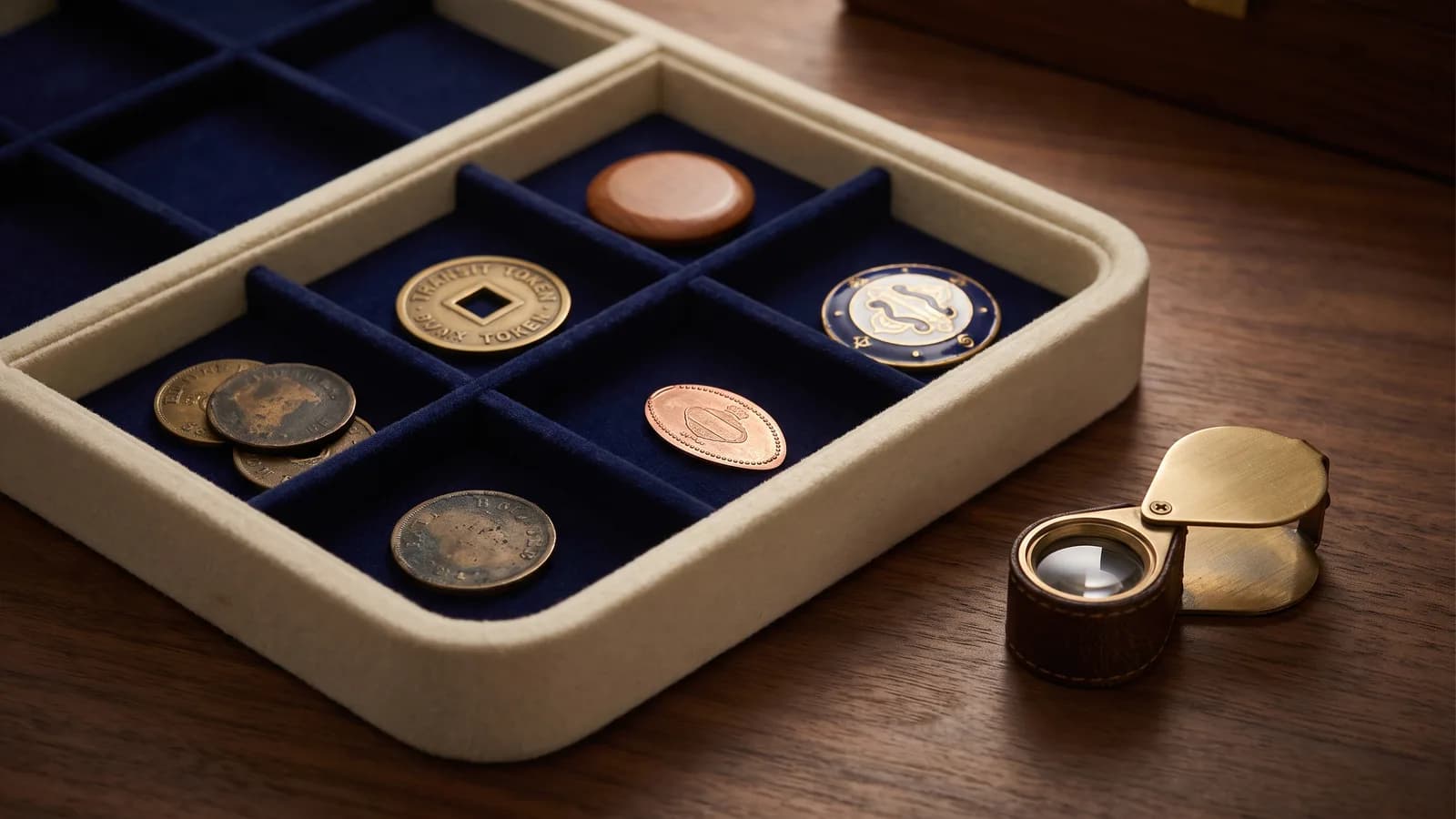
Key takeaways
- Collectible tokens fall under exonumia, the collecting of numismatic items other than government coins and paper money, and most families are affordable and history-rich.
- The biggest value driver across nearly every token family is attribution: a piece tied to a named town, merchant, or system is usually worth far more than an anonymous one.
- Common examples in most families run from a few cents to about $20, while scarce, well-attributed, early, or error pieces reach the tens, hundreds, or more.
- Engraving, counterstamping, or pressing normally destroys a coin's numismatic value, so love tokens, counterstamps, and elongated coins are collected as folk art or novelty, not for the host coin.
What Are Collectible Tokens, and How Do They Differ From Coins and Medals?
A collectible token is a coin-like object that a private business, transit system, town, or organization made for a specific purpose rather than as official government money. Unlike a circulating coin, a token usually only had value in one place or for one use, such as one streetcar fare or five cents in trade at a single store.
Tokens also differ from the classic tokens and medals already covered elsewhere on the site. A medal is a commemorative piece made to honor a person, event, or achievement and was never meant to spend, which you can read more about in our guide to collecting medals. Civil War tokens and Hard Times tokens are their own well-studied categories, covered in our Civil War tokens guide and Hard Times tokens guide. The families below are the everyday tokens most people actually inherit or dig up.
All of these fall under exonumia, a term collectors use for numismatic material outside official coins and banknotes. You can see an overview of the broader field at Wikipedia's exonumia page and general collecting resources from the American Numismatic Association.
| Family | What it is | Main era | Typical value |
|---|---|---|---|
| Trade tokens | Merchant good-for tokens redeemable at one business | 1870s-1930s | $2-$20 common; more if attributed |
| Transportation tokens | Fare tokens for streetcars, buses, ferries, bridges | Late 1800s-late 1900s | $1-$10 common |
| Sales-tax tokens | Mill tokens for fractional-cent sales tax | 1930s-1940s | A few cents to about $1 |
| Wooden nickels | Flat wooden token coins, scrip or promo | 1930s and modern | Cents to $1 modern; $50-$150+ Depression scrip |
| Love tokens | Coins smoothed and hand-engraved as keepsakes | 1860s-1900s | $20-$50 simple; much higher elaborate |
| Elongated coins | Coins rolled and stretched with a souvenir design | 1893-present | Cents to low hundreds for early pieces |
| Encased coins | A real coin set in a ring as a good-luck advertiser | Early 1900s-present | $3-$15 common |
| Counterstamped coins | Genuine coins punched with a merchant or maker mark | Mostly 1800s | Modest to thousands |
| Challenge coins | Military or unit medallions carried by members | Korea/Vietnam era-present | A few dollars to real premiums |
What Are Trade Tokens and Maverick Tokens?
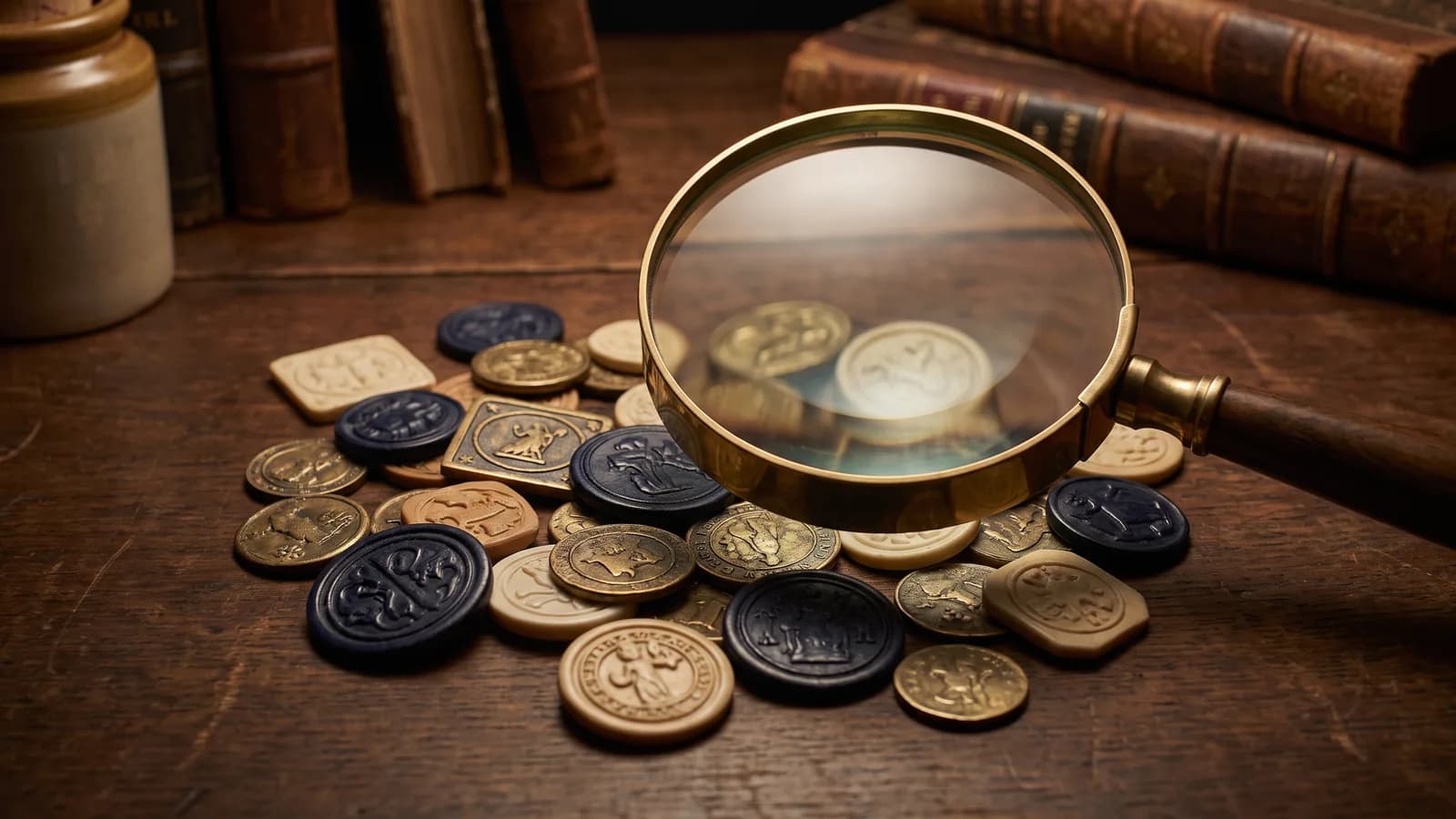
Trade tokens, also called merchant tokens or good-for tokens, are privately issued pieces that a business gave or sold to customers and redeemed only at that business. They typically read something like GOOD FOR 5 CENTS IN TRADE or GOOD FOR ONE DRINK, ONE LOAF, or ONE FARE, and they were common from roughly the 1870s into the 1930s from saloons, general stores, company stores, dairies, and pool halls. Most are brass or aluminum.
A maverick is a trade token that shows no town or state, and sometimes no merchant, so it cannot be tied to a place. Mavericks are generally worth less than fully identified tokens because attribution is what collectors pay for. Common trade tokens run about $2-$20, while scarce, well-attributed, saloon, or territorial-era pieces reach the tens to hundreds or more. Our trade tokens guide covers attribution and catalogs in depth.
What Are Transportation Tokens?
Transportation tokens are fare tokens used on streetcars, buses, subways, ferries, toll bridges, and turnpikes, often with a distinctive cutout or shape so fare collectors could recognize them by touch. They were widely used from the late 1800s through the late 1900s, before farecards and electronic fares replaced them.
The standard reference is the Atwood-Coffee Catalogue of United States and Canadian Transportation Tokens, and pieces are cited by their AC numbers, organized by state and city. Collectors are called vecturists and organize through the American Vecturist Association. Most transportation tokens are inexpensive, commonly about $1-$10, while scarce early, small-system, or error and off-metal pieces bring more. See our transportation tokens guide for identification tips.
What Are Sales-Tax Tokens?
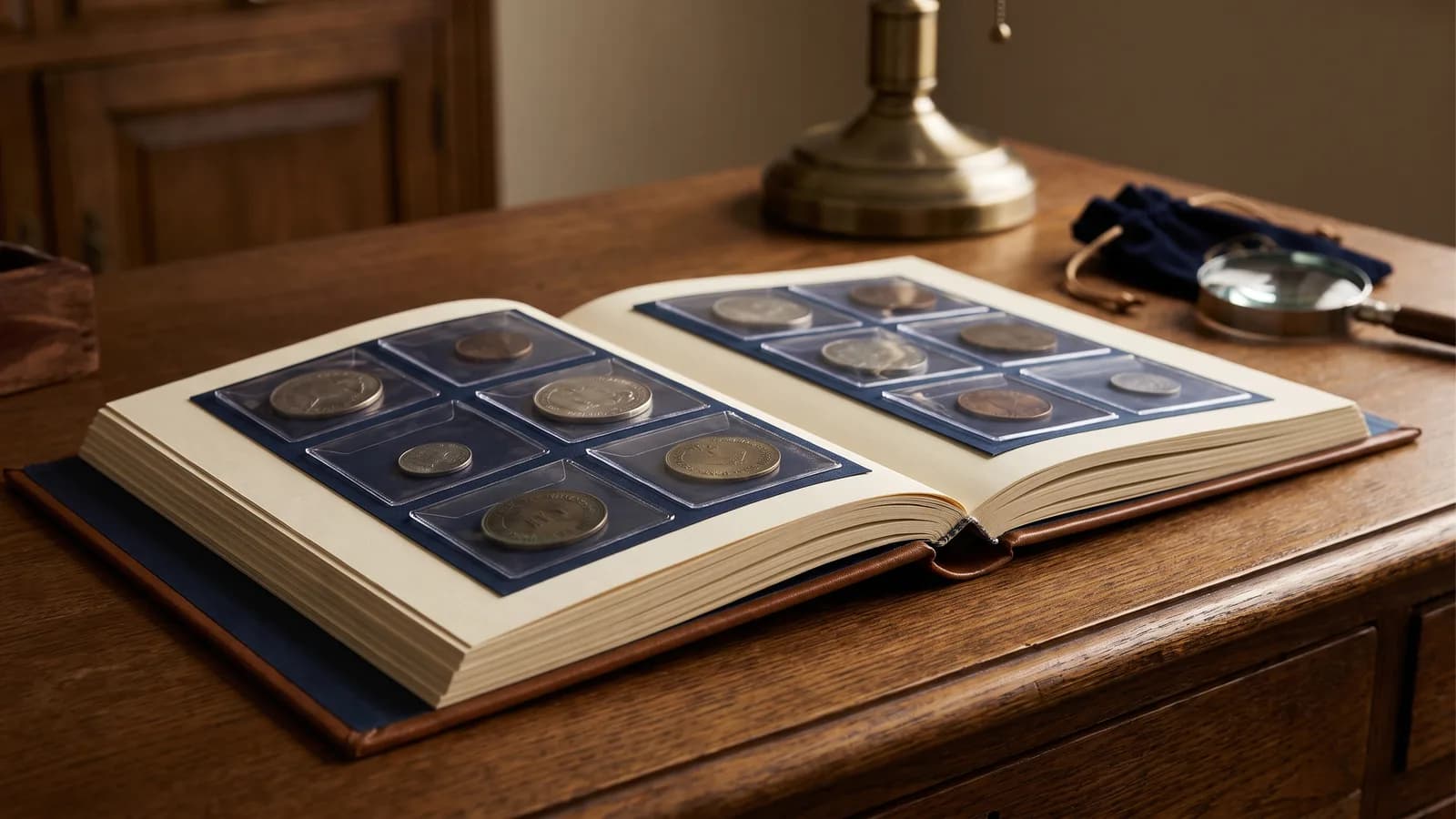
Sales-tax tokens are tiny tokens issued in the 1930s and 1940s so shoppers could pay the fractional-cent sales tax on small purchases without being rounded up a full cent. Denominations are in mills, where one mill equals one-tenth of a cent, most commonly 1 mill and 5 mills.
Twelve states issued them: Alabama, Arizona, Colorado, Illinois, Kansas, Louisiana, Mississippi, Missouri, New Mexico, Oklahoma, Utah, and Washington. They were made in aluminum, zinc, brass, fiber, cardboard, and colorful plastic, in the hundreds of millions, so most survive today and are worth only a few cents to about a dollar. Scarce varieties, errors, and certain state and material combinations are worth more. They faded out between the 1940s and 1960s as sales-tax systems changed. Our sales-tax tokens guide breaks down the states and materials.
What Are Wooden Nickels?
A wooden nickel is a flat wooden token coin, and there are two very different eras collectors care about. The first is Depression-era emergency scrip, most famously from Tenino, Washington, which issued wooden money in 1931 after the Citizens Bank of Tenino failed, followed by Blaine, Washington and Pismo Beach, California. The 1933 Chicago World's Fair also issued wooden nickel souvenirs.
The second era is modern promotional wooden nickels that businesses hand out, sometimes good for a small discount, which keep the tradition and the old saying do not take any wooden nickels alive. Modern promotional pieces are worth a few cents to a dollar, while genuine Depression-era town scrip in nice condition commonly runs about $50-$150 or more depending on the town and rarity. See our wooden nickels guide for the notable towns.
What Are Love Tokens?
A love token is a coin, most classically a dime, that an engraver smoothed on one or both sides and then hand-engraved with initials, a monogram, a name, a date, or a small scene, given as a keepsake or worn as jewelry. They were popular in the United States from about the Civil War era through the turn of the 20th century.
Engraving normally destroys a coin's numismatic value, so love tokens are collected as folk art and personal history rather than for the host coin. Simple initialed pieces commonly run $20-$50, while elaborate multi-symbol engravings, gold hosts, and love-token jewelry such as bracelets and brooches run much higher. Our love tokens guide covers hosts, styles, and dating.
What Are Elongated Coins (Pressed Pennies)?
An elongated coin, also called a pressed or squished penny, is a coin rolled under heavy pressure through a die-engraved roller, which stretches it oval and impresses a souvenir design. The first United States elongateds were made at the 1893 World's Columbian Exposition in Chicago, where machines pressed visitors' coins for a few cents.
Collectors organize through The Elongated Collectors. Modern souvenir elongateds are worth little more than the coin and the novelty, while early pieces, 1893 Columbian Exposition rollings, and scarce older rollers bring tens to low hundreds of dollars. Our elongated coins guide explains rollers, dating, and what makes an early piece valuable.
What Are Encased Coins?
An encased coin is a real coin, usually a cent, mounted inside a metal ring, most often aluminum, as an advertising good-luck piece. They typically read KEEP ME AND NEVER GO BROKE or GOOD LUCK along with a business name, and they have been common from the early 1900s to the present.
This is different from Civil War encased postage, which is a postage stamp held in a brass frame with a mica window, covered in our encased postage stamps guide. Common encased cents run about $3-$15, while older pieces, scarcer advertisers, higher denominations, or pieces tied to expositions bring more. Our encased coins guide covers advertisers and dating.
What Are Counterstamped Coins?
A counterstamped or countermarked coin is a genuine host coin into which someone punched a mark, most often a merchant's name or initials for advertising, a maker's or assayer's hallmark, or a slogan. This practice was common in the 19th century and turned ordinary coins into moving advertisements.
The standard reference is Gregory Brunk's catalog of American and Canadian merchant and privately countermarked coins, which lists roughly 13,500 stamps. Value ranges widely: ordinary merchant stamps are modest, while historically important stamps such as early gold-rush assayers, patent-medicine makers, or political counterstamps reach the hundreds to thousands. A key skill is telling an intentional counterstamp from graffiti or damage, which the Brunk reference and third-party certification help with. See our counterstamped coins guide.
What Are Military Challenge Coins?
A challenge coin is a small medallion bearing a unit's or organization's insignia, carried by its members and often exchanged by a handshake, and it is collected as modern exonumia. Its origins are debated, with a popular story dating to a World War I aviator's squadron medallions, but the first well-documented unit coins appeared during the Korean and Vietnam eras, for example the 17th Infantry and the 10th Special Forces Group.
The coin check is a bar tradition tied to these pieces. Most modern challenge coins are valued sentimentally or at a few dollars, while scarce historic unit coins, early presidential coins, and low-numbered pieces command real premiums. Our military challenge coins guide covers history and collecting.
How Do You Identify and Research an Unknown Token?
Start by reading every word and number on both sides, noting the metal, shape, size, any cutout, and any town, state, business name, or denomination. Those details point you to the right family and reference, and attribution is where nearly all of the value lives.
Worked example, a maverick trade token. Suppose you find a brass piece reading GOOD FOR 5 CENTS IN TRADE on one side and just the initials J.M. SALOON on the other, with no town. Because there is no place name, it is a maverick, and mavericks are worth less until attributed. You would compare it against state trade-token books and an online token database, cross-checking the wording, the denomination, and the maker's mark. If a researcher matches J.M. to a documented saloon in a small, short-lived town, the token can jump from a couple of dollars to much more, because saloon and small-town pieces are prized.
Worked example, a transit token. Suppose you find a small token with a triangular cutout reading CITY LINES GOOD FOR ONE FARE. The cutout and fare wording identify it as a transportation token, and you would look it up by state and city in the Atwood-Coffee catalog to find its AC number and rough scarcity. Most such pieces settle around $1-$10, so identification mainly confirms what you have rather than uncovering a windfall. When wording is ambiguous, the free resources at the Newman Numismatic Portal and specialty club sites are good next stops. If a coin has been altered rather than privately issued, our guides on why you should never clean coins and how to spot fake coins can help you avoid mistakes.
What Drives a Token's Value?
Across every family, the single biggest value driver is attribution, meaning a clear link to a named town, merchant, system, or unit. Beyond that, scarcity, condition, metal, historical significance, and collector demand set the rest of the price.
A few patterns hold widely. Named small-town and territorial pieces beat anonymous mavericks. Saloon, gold-rush, and exposition connections add a premium. Errors, off-metals, and unusual materials attract specialists. Early dates within a family, such as 1893 elongateds or first-generation town scrip, outperform later ones. Condition matters, but for folk-art and advertising pieces the story often matters more than a technical grade. Because these markets are thin, comparing recent sold prices for the same attributed piece is the most reliable way to set expectations. For the deeper mechanics of condition, our coin grading explained guide gives useful background.
Where Can You Buy, Sell, and Appraise Collectible Tokens?
You can buy and sell collectible tokens through coin shops, specialty token dealers, coin shows, club auctions, and online marketplaces, and the right venue depends on how scarce and valuable the piece is. Common tokens move well online and at shows, while scarce, attributed pieces do best with a specialist who has the right buyers.
To find help near you, browse the coin shops directory and the medals and tokens category. If you inherited a box of mixed material, a numismatic appraiser or an estate coin buyer can sort common from scarce and give you a realistic figure before you sell. Our guide on how to sell an inherited coin collection walks through the process, and coin shows are a good place to compare offers. When you inherit an unsorted box, resist the urge to clean anything and get the scarce pieces identified first.
How Should You Store Collectible Tokens?
Store tokens in inert, non-PVC holders such as flips, capsules, or archival 2x2 pages, kept in a cool, dry, stable place away from humidity and temperature swings. PVC holders can leave a green residue that damages metal over time, so avoid soft vinyl flips.
Do not clean tokens, since cleaning removes original surface and value, a point covered in why you should never clean coins. Keep any attribution notes, town names, or research with each piece, because for tokens the documented story is often worth as much as the object. If you are new to organizing a collection, our coin collecting for beginners guide covers holders, storage, and record keeping.
Frequently asked questions
What is the difference between a token and a coin?+
A coin is official money issued by a national mint and spendable anywhere. A token is a privately made, coin-like piece with value only in one place or for one purpose, such as one fare or five cents in trade at a single store.
Are collectible tokens valuable?+
Most are affordable, commonly a few cents to about $20. Value rises sharply for scarce, early, or well-attributed pieces tied to a named town, merchant, or system, which can reach the hundreds or more.
What is a maverick token?+
A maverick is a trade token that shows no town or state, and sometimes no merchant, so it cannot be attributed to a place. Mavericks are generally worth less than fully identified tokens until a researcher matches them to a location.
How do I find out what an unknown token is worth?+
Read every word and number, note the metal and any cutout, then match it to the right family reference such as Atwood-Coffee for transit tokens or Brunk for counterstamps. Compare recent sold prices for the same attributed piece, or ask a numismatic appraiser.
Should I clean an old token before selling it?+
No. Cleaning removes original surface and usually lowers value. Keep tokens as found and store them in non-PVC holders, and preserve any notes about the town, merchant, or system, since attribution drives value.
Are challenge coins considered collectible tokens?+
Yes. Challenge coins are modern exonumia, the same broad field as trade and transit tokens. Most are worth a few dollars or hold sentimental value, while scarce historic unit coins and early presidential pieces command real premiums.