
Bicentennial Coins Value: Are 1776–1976 Quarters Worth Money?
Most Bicentennial coins are worth exactly their face value, despite viral posts claiming otherwise. To mark the nation's 200th birthday, the 1776–1976 quarter, half dollar, and dollar were given special reverse designs, and the vast majority were ordinary clad coins made by the hundreds of millions. This guide gives the honest picture: which Bicentennial coins contain silver, why most are common, and the narrow exceptions that are actually worth more.
Key takeaways
- Most Bicentennial quarters, halves, and dollars are circulating clad coins worth only face value.
- Viral claims that ordinary Bicentennial quarters are worth thousands are almost always false.
- The Mint sold special 40% silver Bicentennial coins in collector sets, which are worth their silver content.
- Real premiums apply only to high-grade certified coins, genuine errors, and the silver collector versions.
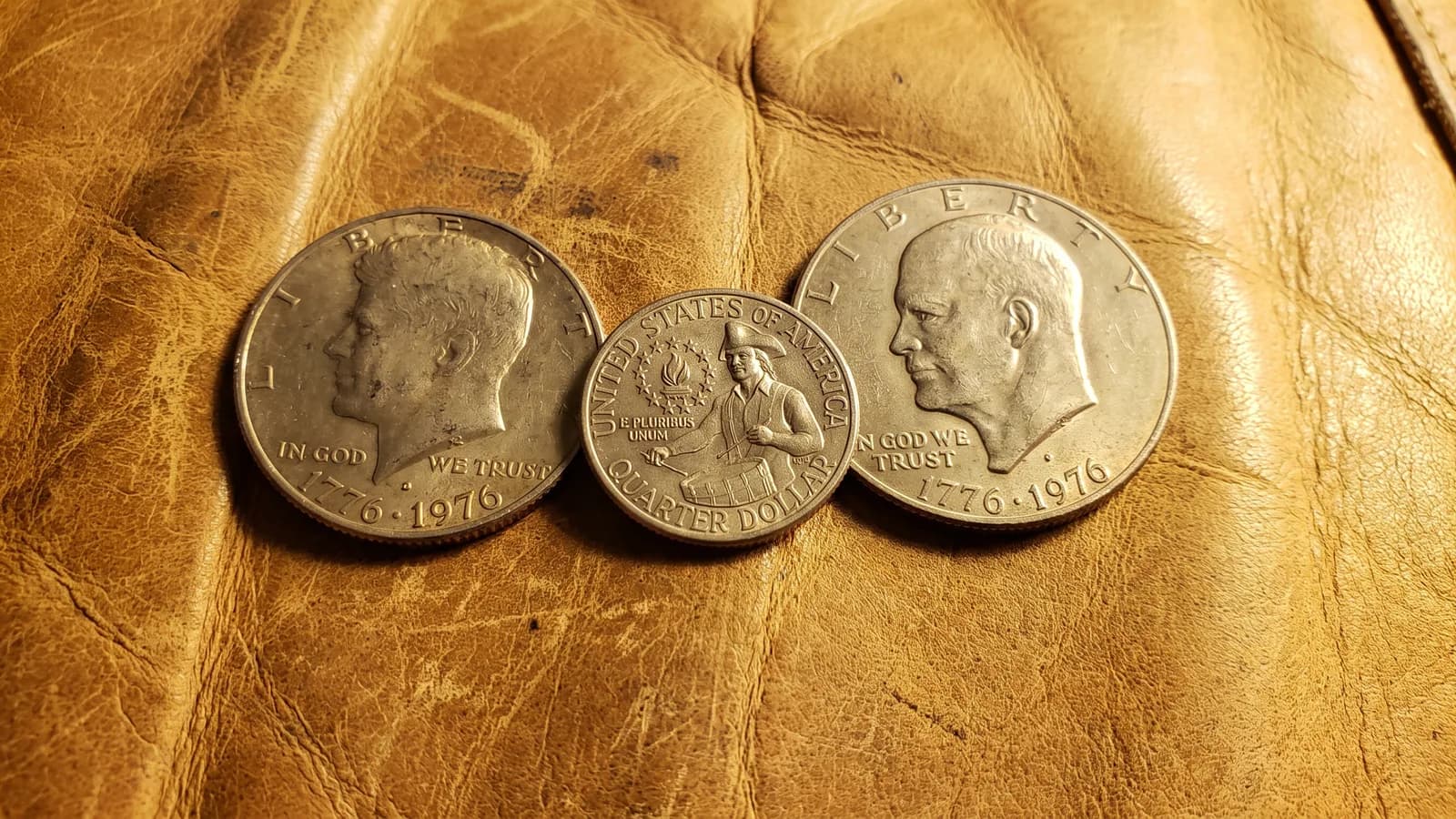
- All Bicentennial coins are dual-dated 1776–1976 with special reverse designs.
Are Bicentennial coins valuable?
For the most part, no. The Bicentennial quarter, half dollar, and dollar were struck in enormous numbers as clad coins, and circulated examples are worth face value. They are interesting and historic, but not rare.
The exceptions are narrow: the 40% silver collector versions, top-grade certified coins, and genuine error coins. Everything else is a face-value coin.
What are Bicentennial coins?
They are the 1776–1976 dual-dated coins issued for the United States Bicentennial. The quarter shows a colonial drummer, the half dollar shows Independence Hall, and the dollar shows the Liberty Bell over the moon.
Coins of these three denominations made in 1975 and 1976 all carry the 1776–1976 date — there are no 1975-dated quarters, halves, or dollars.
Which Bicentennial coins contain silver?
Circulating Bicentennial coins are copper-nickel clad with no silver. The Mint also sold special 40% silver versions of all three denominations in collector sets, struck at San Francisco with an S mint mark.
Those silver coins are worth their metal content, shown below. A silver Bicentennial coin will carry an S mint mark and, ideally, still be in its original Mint set.
| Coin | Silver content (approx.) |
|---|---|
| Bicentennial quarter | 0.0739 troy oz |
| Bicentennial half dollar | 0.1479 troy oz |
| Bicentennial dollar | 0.3162 troy oz |
Why do people think Bicentennial quarters are worth thousands?
Social media and some sales listings repeat claims that ordinary 1776–1976 quarters are worth thousands of dollars. These claims are almost always false and rely on confusing rare, certified, top-grade coins or errors with the common clad coins nearly everyone has.
A circulated Bicentennial quarter is worth 25 cents. The honest test is simple: unless a coin is a verified high grade, a 40% silver issue, or a genuine error, treat it as face value.
Which Bicentennial coins are actually worth more?
Three categories: the 40% silver collector versions (worth their silver), top-grade certified coins graded by PCGS or NGC in the highest mint-state levels, and genuine error coins such as off-center strikes or doubled dies.
Because high grade and errors drive these premiums, authentication matters. Our guides to which grading companies to trust and spotting fake coins explain how to avoid inflated claims.
How do you value and sell Bicentennial coins?
For silver versions, value them on metal with our precious metals value calculator; see also our Washington quarter and Kennedy half dollar guides for the related series.
Sell silver Bicentennial coins to an established coin shop or gold and silver buyer. For a coin you believe is a rare grade or error, get it authenticated before expecting a premium.
Frequently asked questions
Are Bicentennial quarters worth anything?+
Circulating 1776–1976 quarters are clad and worth face value. Only the 40% silver collector versions, top-grade certified coins, and genuine errors are worth more.
How do I know if my Bicentennial coin is silver?+
Silver Bicentennial coins carry an S mint mark and were sold in special Mint collector sets. The surest confirmation is the original packaging or the coin's weight, since clad versions are common.
Why are some Bicentennial quarters listed for thousands of dollars online?+
Those listings are almost always misleading. They confuse rare high-grade certified coins or errors with ordinary clad coins. A normal circulated Bicentennial quarter is worth 25 cents.
How much silver is in a Bicentennial half dollar?+
The 40% silver collector version contains about 0.1479 troy ounces of silver. Circulating Bicentennial halves are clad with no silver.