
Coin Collecting Glossary: 50 Terms Every Collector Should Know
Numismatics — the study and collection of coins, paper money, and related objects — has developed a specialized vocabulary over 200 years. For new collectors, the first conversation with a dealer or forum post can be bewildering: AG-3, MS-65, PCGS, key date, bag mark, trime, cartwheel luster. This glossary defines 50 of the most commonly used terms across grading, coin identification, and the market, so you can read price guides, understand auction descriptions, and talk with dealers confidently.
Key takeaways
- The Sheldon grading scale (1–70) is the universal standard for U.S. coin grades; MS-60 to MS-70 are Mint State (uncirculated).
- PCGS and NGC are the two most respected third-party coin grading and authentication services.
- "Melt value" is what a coin's precious metal content is worth at current spot prices — the floor for bullion coins.
- A "key date" is a scarce, high-demand coin needed to complete a collection — usually the most expensive date in a series.
- "Original surfaces" means the coin has never been cleaned, polished, or chemically treated — highly desirable to collectors.
Grading Scale and Grade Abbreviations
Sheldon scale: The 1–70 numerical grading system used for all U.S. coins, originally introduced by Dr. William Sheldon in 1949. Poor (P-1): Barely identifiable. Fair (F-2): Heavily worn, date visible. About Good (AG-3): Outline visible, most detail gone. Good (G-4/G-6): Heavily worn, major design clear. Very Good (VG-8/VG-10): Moderate wear, design clear. Fine (F-12/F-15): Even wear, all major features distinct. Very Fine (VF-20 to VF-35): Light wear on high points. Extremely Fine (EF-40/EF-45, also written XF): Slight wear on high points only. About Uncirculated (AU-50 to AU-58): Traces of wear only on highest points; most original luster present.
Mint State (MS-60 to MS-70): No wear. MS-60: Heavy bag marks. MS-63: Moderate marks. MS-65: Gem, few light marks. MS-67: Superb gem. MS-70: Perfect (rare). Proof grades: PF-60 through PF-70, same scale applied to proof coins. Details grade: Coin has a problem (cleaned, damaged, holed) that prevents a straight numeric grade.
Coin Anatomy Terms
Obverse: The front face of a coin, typically carrying the portrait. Reverse: The back face. Field: The flat background area. Device/Relief: The raised design elements. Legend: The primary inscription. Motto: A secondary phrase ("E PLURIBUS UNUM," "IN GOD WE TRUST"). Exergue: The lower portion of the coin face, often containing the date. Rim: The raised outer border on both faces. Edge: The narrow outer surface of the coin (reeded, plain, or lettered). Mintmark: Letter(s) indicating the Mint facility (P, D, S, O, CC, W, C, D for Dahlonega).
Die: The hardened steel tool that strikes the design into a coin. Planchet: The blank metal disk struck by the die. Hub: The positive master die used to create working dies. Clash marks: Impressions left on a die when obverse and reverse dies strike each other without a planchet between them.
Surface and Quality Terms
Luster: The sheen on an uncirculated coin created by metal flow during striking. Cartwheel luster: The rotating brightness seen when a Mint State coin is tilted. Strike: How fully the dies transferred the design to the coin. Weak strike: A coin where design details are shallow due to insufficient striking pressure or worn dies. Bag marks: Contact marks from coins touching each other in Mint bags — normal on business-strike coins. Hairlines: Fine scratches, especially damaging on proof fields.
Toning: Chemical discoloration of the coin's surface — natural or artificial. Patina: Natural chemical change to a coin's surface, especially on copper. PVC damage: Green, sticky residue from soft plastic (PVC) coin holders that reacts with silver over time. Carbon spot: A dark spot on a silver coin's surface caused by organic contamination. Original skin / original surfaces: The coin has never been cleaned, dipped, or chemically treated.
Market and Rarity Terms
Key date: The scarcest, most expensive date in a series — essential for a complete collection. Semi-key: A date that is scarce but not the rarest in the series. Melt value: The intrinsic precious metal value of a coin at current spot prices. Premium over melt: The additional amount paid above melt value, reflecting numismatic demand. Wholesale/bid price: What a dealer will pay to buy a coin. Retail/ask price: What a dealer charges to sell.
Pop report: PCGS or NGC's certified population data showing how many examples of a coin in each grade they have certified — the primary rarity reference. Registry set: A collection of certified coins in the highest grades, tracked competitively in PCGS or NGC set registries. CAC: Certified Acceptance Corporation — issues stickers for coins that are solid or premium for their grade. Type coin: One example of a specific design type, regardless of date.
Series and Coin Type Names
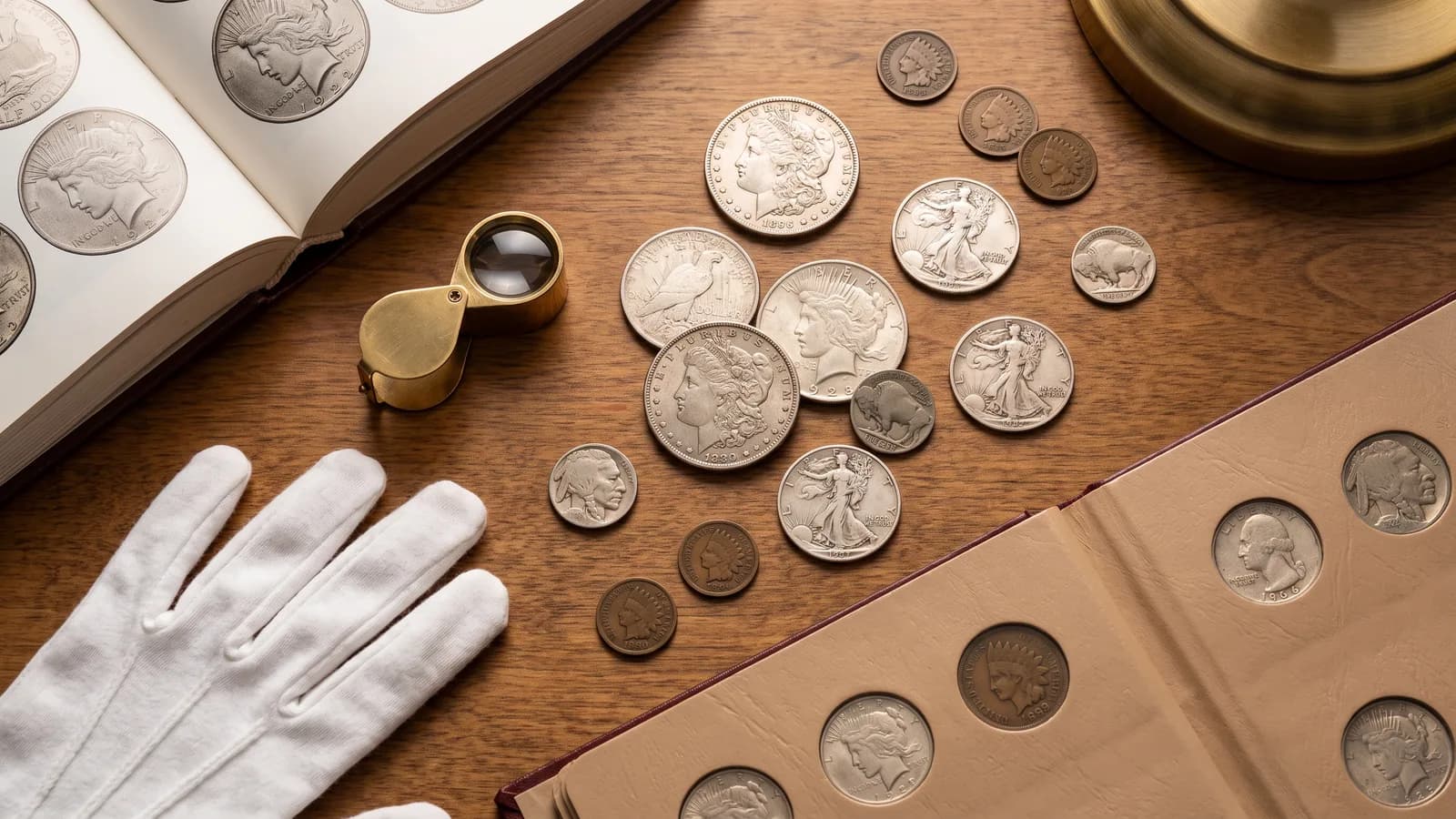
Wheat Penny: Lincoln cents 1909–1958 with wheat ears on the reverse. Memorial Cent: Lincoln cents 1959–2008 with the Lincoln Memorial reverse. Morgan dollar: 1878–1904 and 1921 silver dollar. Peace dollar: 1921–1935 silver dollar. Walking Liberty: Half dollar 1916–1947. Barber: Dime, quarter, and half dollar 1892–1916, designed by Charles Barber. Seated Liberty: Silver coins 1836–1891 with the seated goddess design. Mercury dime: 1916–1945 dime (officially Winged Liberty Head). Standing Liberty quarter: 1916–1930 quarter.
Trime: The silver three-cent piece (1851–1873). Trade dollar: The heavy export silver dollar (1873–1885). Double eagle: $20 gold coin. Eagle: $10 gold coin. Half eagle: $5 gold coin. Quarter eagle: $2.50 gold coin. Junk silver: Pre-1965 circulated U.S. silver coins bought or sold at or near melt value.
Organizations and Third-Party Grading
PCGS (Professional Coin Grading Service): One of the two most widely respected third-party grading and authentication services. Coins are graded, authenticated, and sealed in hard plastic holders ("slabs"). NGC (Numismatic Guaranty Corporation): The other major grading service, equal in reputation and widely accepted. ANA (American Numismatic Association): The largest non-profit coin collecting organization in the United States; publishes The Numismatist. PNG (Professional Numismatists Guild): An organization of established professional coin dealers committed to ethical trading standards.
Slab: The sealed hard plastic holder used by PCGS, NGC, and other grading services. Slabbed coins have a tamper-evident seal, grade label, and barcode. Raw coin: A coin that has not been submitted to a third-party grading service and is unslabbed. Raw coins may be authentic and problem-free, or not — the buyer assumes more risk.
Frequently asked questions
What does MS-65 mean on a coin?+
MS stands for Mint State (uncirculated). The number 65 is the grade on the Sheldon 70-point scale. MS-65 is considered gem quality — a coin with full original luster, well-struck, and only a few light, scattered bag marks. It is a premium grade that commands a significant price over lower Mint State grades.
What is the difference between Fine and Very Fine?+
Fine (F-12) indicates even, moderate wear across the coin — major design elements are clear but high-point detail is worn flat. Very Fine (VF-20 to VF-35) shows light wear only on the high points; most design detail remains sharp. The difference is visible to the naked eye.
What does "original surfaces" mean and why does it matter?+
Original surfaces means the coin has never been cleaned, dipped, polished, or chemically altered. Collectors strongly prefer original surfaces because cleaning destroys the luster and toning that authenticate a coin's natural aging. Cleaned coins sell for 30–70% less than original examples.
What is the difference between PCGS and NGC?+
Both PCGS and NGC are highly respected, widely trusted third-party grading services. Their grades are generally treated as equivalent by the market. Some specific coins or series have slight differences in how each service grades them, but for most collectors either service is equally acceptable.
What does "key date" mean in coin collecting?+
A key date is the rarest, most sought-after date (and sometimes mintmark) in a coin series — the one that costs the most and is hardest to find. Examples include the 1909-S VDB Lincoln cent, the 1916-D Mercury dime, and the 1893-S Morgan dollar. Owning the key date is often the capstone of completing a series.