
Mint Sets vs. Proof Sets: Which Annual U.S. Coin Sets Are Worth Buying?
Every year, the U.S. Mint sells two primary types of annual coin sets directly to collectors: the uncirculated **Mint Set** (containing business-strike coins from each active Mint facility) and the **Proof Set** (containing proof-finish coins struck at the San Francisco Mint). Understanding the difference — and what each is actually worth on the secondary market — can save you money and focus your collecting.
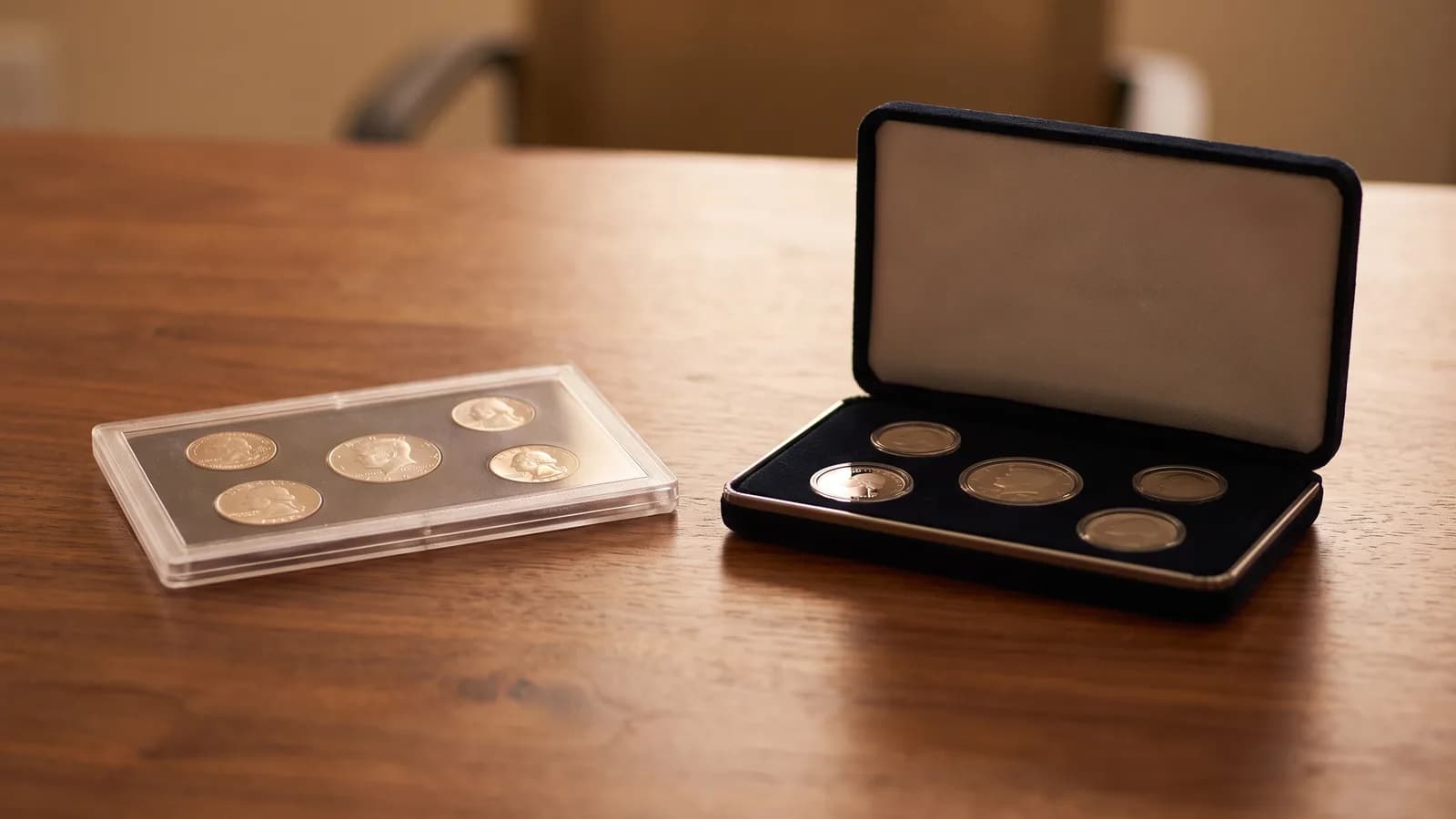
Key takeaways
- U.S. Mint sets contain uncirculated business-strike coins; proof sets contain proof-finish coins struck at the San Francisco Mint.
- Annual proof sets have been issued since 1950 (with gaps); uncirculated mint sets since 1947.
- Silver proof sets — containing 90% silver dimes, quarters, and half dollars — are more valuable than clad proof sets of the same year.
- Most clad proof sets from 1968–2000 are available on the secondary market for $5–$20, far below their original issue prices.
- Key years with lower mintages or special compositions can be worth significantly more than surrounding years.
What Is a U.S. Mint Set?
An annual uncirculated Mint Set contains one example of each coin denomination in production that year, from each Mint facility that struck them. In most recent years, that means Philadelphia (P) and Denver (D) coins packaged together. The coins are business strikes — normal coins struck for circulation but removed before reaching commerce — not proof coins.
Mint sets have been issued since 1947 (with a gap 1965–1967, when Special Mint Sets were issued instead). They come in government packaging — typically a sealed envelope or plastic blister pack with a certificate of authenticity from the Mint.
What Is a U.S. Proof Set?
A proof set contains proof-finish coins struck on polished planchets with polished dies at the San Francisco Mint. Modern proof coins have mirror-bright fields and frosted devices. A standard annual proof set includes the cent, nickel, dime, quarter(s), half dollar, and dollar (when in production) — all in proof finish.
Proof sets have been issued annually since 1950 (with a gap 1965–1967, when no standard proof sets were made). They come in an official U.S. Mint presentation case, typically a hard plastic holder.
Silver Proof Sets: The Valuable Version
Each year since 1992, the U.S. Mint has also offered a Silver Proof Set alongside the standard clad proof set. Silver proof sets contain 90% silver versions of the dime, quarters, and half dollar — the same compositions as pre-1965 circulated coins. The dollar and cent remain standard composition.
Silver proof sets are more valuable than clad sets because of their silver content. A 2024 silver proof set with five 90% silver quarters (America the Beautiful or similar program) contains meaningful silver melt value plus collector premium. Use our silver melt calculator to calculate current silver value for any year's silver set.
Secondary Market Values: The Reality
The uncomfortable truth about most proof sets and mint sets is that their secondary market value is far below their original issue price. Tens of millions of sets were issued from the 1960s through the 1990s, creating a massive supply relative to collector demand. Most clad proof sets from 1968–2000 sell for $5–$20 in the secondary market, regardless of their $10–$25 original issue prices.
This does not mean they are worthless — they contain genuine proof coins in original government packaging. But anyone who purchased proof sets as "investments" expecting appreciation has generally been disappointed. Exception: silver proof sets from 1992–present hold their silver melt value and often sell for $30–$80+ depending on silver prices and year.
Which Years Are Worth Seeking?
Key years with lower mintages or special compositions stand out. 1950 proof set (mintage ~51,000): complete sets sell for $200–$500. 1955 proof set (mintage ~378,000): $150–$300. 1955 Mint Set (lower mintage): worth a premium. 1960 proof set with small date cent: the small date version commands $25–$75 above the large date.
For modern issues, the prestige proof sets (1983–1997 and similar special sets) often contain coins with lower mintages. Annual sets from 1982–1983 (when no mint sets were issued) are slightly scarcer. A local coin dealer can advise on which years in your budget have the strongest collector following.
Should You Buy Mint Sets or Proof Sets?
As a collector of modern U.S. coinage, proof sets offer the most visually impressive presentation and the best-preserved coins. If you want silver composition and maximum collector appeal, silver proof sets are the clear choice. Mint sets offer a better cross-section of business-strike quality and are generally less expensive.
As investments, neither has performed well over most time periods — the supply is simply too large. Buy sets because you enjoy the coins and the collecting experience, not because you expect them to appreciate significantly. For historical sets (pre-1965), values are more stable because the supply is fixed and some silver sets have meaningful melt floors.
Frequently asked questions
What is the difference between a proof set and a silver proof set?+
A standard (clad) proof set contains proof-finish coins in normal copper-nickel-clad composition. A silver proof set contains 90% silver dimes, quarters, and half dollar — the same silver content as pre-1965 circulation coins — plus standard-composition cent and dollar.
Are proof sets from the 1970s valuable?+
Most clad proof sets from 1968–1980 sell for $8–$20 on the secondary market, well below original issue prices. Mintages were very high. The silver-composition proof sets from this era (pre-1965 issues) are a different matter and worth significantly more.
Where is the best place to sell old proof sets?+
Local coin dealers, coin shows, and online platforms (eBay, Great Collections) are all options. For bulk lots of common clad sets from the 1970s–1990s, expect $8–$15 per set. For silver or prestige sets, a coin dealer will assess individual value.
Do proof sets from 1964 and earlier contain silver?+
Yes. Proof sets from 1950–1964 contain 90% silver dimes, quarters, and half dollars (and 90% silver dollars where applicable). These sets have silver melt value plus numismatic premium and are worth considerably more than equivalent clad sets.
What is a "Special Mint Set" (SMS)?+
From 1965 to 1967, the U.S. Mint stopped producing proof sets and mint sets and instead issued Special Mint Sets — coins struck with more care than business strikes but not to proof standards. SMS coins have a satin-like finish and are collected separately by type.