
John Adams Bolen: The Springfield Die-Sinker and His Medals
John Adams Bolen was a respected 19th-century die-sinker in Springfield, Massachusetts whose store cards, commemorative medals, and struck copies of famous early American coins are prized by exonumia collectors. Born in New York City in 1826, he set up shop in Springfield and worked in metal from the early 1850s until his death in 1906. What makes Bolen distinctive is that his copies of rare colonial and early American pieces were sold openly to collectors of his own day, not made to deceive, which is why the numismatic community still values them as work of a known maker.
Key takeaways
- John Adams Bolen (born November 10, 1826, in New York City) worked as a die-sinker in Springfield, Massachusetts from the early 1850s until his death in 1906.
- His body of work includes Civil War-era store cards, Springfield commemorative medals, and struck copies of rare early American and colonial pieces such as Higley coppers and Bar coppers.
- Bolen sold his copies openly to collectors as reproductions rather than passing them as genuine, which separates them from counterfeits made to defraud.
- The standard reference is Neil Musante's 2002 catalog, and Bolen pieces are cited by Musante JAB numbers.
- Desirable Bolen pieces, especially rarer metals and higher grades, commonly trade into the hundreds of dollars and up.
Who Was John Adams Bolen?
John Adams Bolen was a die-sinker, an engraver who cuts the hardened steel dies used to strike medals and tokens, who built his reputation in Springfield, Massachusetts. He was born in New York City on November 10, 1826, moved to Springfield around 1851, and was advertising as a die-sinker by 1853.
Bolen worked at his craft for roughly half a century, until his death in 1906. Locally he was known to Springfield merchants and antiquarians, while the wider collecting community knew him best for his skilled reproductions of rare early coins. His work has been sought by collectors since the pieces were first issued, and it sits within the broader field of medal collecting.
What Kinds of Pieces Did Bolen Make?
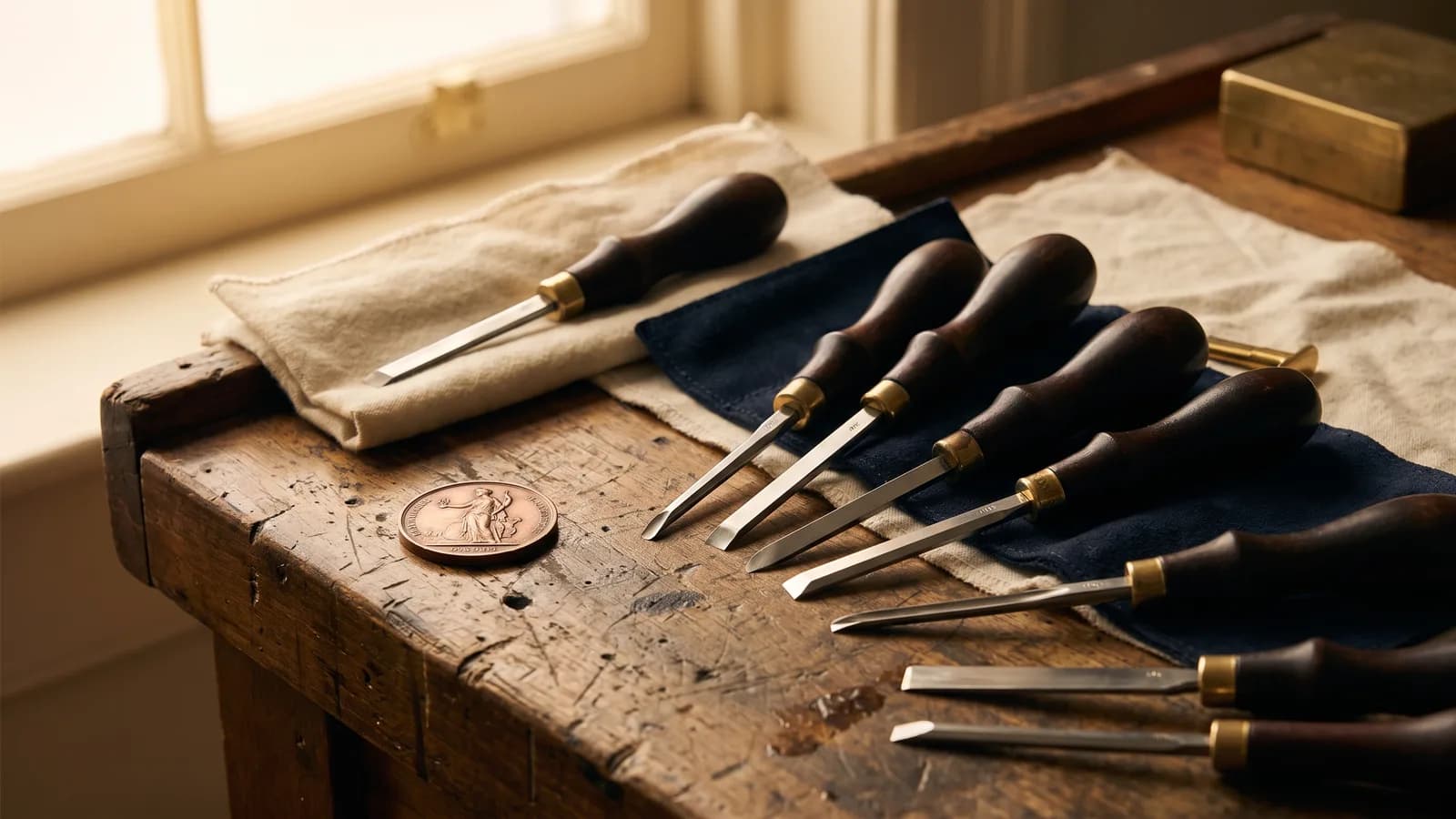
Bolen's output falls into three broad groups: store cards for local businesses, commemorative medals tied to Springfield people and events, and struck copies of famous early American coins. Together his dies produced a modest number of designs but a much larger number of variations, because he struck many pieces in several different metals.
His first medallic commission was a piece for the Pioneer Baseball Club, a Springfield-area team, and store cards advertising his own business are also part of the record. These sit alongside the reproductions that made his name among coin collectors. For context on the token side of his work, see our guide to Civil War tokens, the category that includes merchant store cards of the 1860s.
| Type | What it is | Collectibility (hedged) |
|---|---|---|
| Store cards | Advertising tokens for local businesses, including his own | Widely collected as Civil War-era exonumia; common examples often affordable, scarcer metals higher |
| Commemorative medals | Pieces honoring Springfield people, places, and events | Steady collector demand; value varies with subject, metal, and grade |
| Copies of early coins | Struck reproductions of rare colonial and early American pieces | Often the most sought; rarer metals and high grades commonly reach the hundreds and up |
Which Early American Coins Did Bolen Copy?
Bolen struck copies of several genuinely rare colonial and early American pieces, the kind most collectors of his day could never hope to own. Documented examples include Higley coppers, Bar coppers, and Carolina Elephant tokens, among other Americana.
One well-documented case is his recreation of the 1737 Higley three-pence copper, with pieces struck in copper and brass and a smaller number in silver. Because the originals were far out of reach for ordinary collectors, well-made copies like Bolen's let people study and display designs they would otherwise only read about.
Were Bolen's Copies Counterfeits?
No. Bolen sold his copies openly to collectors as reproductions rather than passing them off as genuine coins, which is the key distinction between his work and a counterfeit made to defraud. A counterfeit is created to deceive a buyer into paying for something it is not; Bolen's pieces were understood as the work of a named contemporary maker.
That said, a handful of Bolen pieces have caused confusion over the years, especially when separated from their history or when a buyer is not familiar with his work. This is why learning to identify a maker's style and authenticate a piece matters. Our guide on how to spot fake coins covers the general principles, and a qualified specialist can confirm attribution.
How Are Bolen Pieces Cataloged?
Bolen's work is cataloged in Neil E. Musante's reference on his medallic output, published in 2002, which is the standard catalog for the series. Individual pieces are cited by Musante JAB numbers, sometimes simply called Bolen numbers.
Musante is a well-known cataloger of American medallic history and also wrote the modern standard reference on numismatic Washingtoniana. Because his Bolen catalog is out of print and sought after, having access to the reference, or to a dealer who owns it, helps when you want to attribute a specific piece and understand how scarce a given variety is.
What Are Bolen Pieces Worth?
Values vary widely by type, metal, and condition, so treat any figure as a range rather than a fixed price. Desirable pieces, particularly the copies of rare coins in scarcer metals or high grade, commonly trade into the hundreds of dollars and up, while more available pieces can be more modest.
Several factors move the price of a given piece: which design it is, the metal it was struck in (silver and other scarce compositions usually command more than copper or brass), the grade and surface color, and how many of that variety are known. Because the same design can exist in several metals, two pieces that look alike can carry very different values. When in doubt, compare recent auction results for the exact Musante JAB variety and metal.
How to Buy Authentic Bolen Pieces
Buy from sources that can document what they are selling and stand behind attribution. Established exonumia dealers, reputable auction houses, and specialists in early American numismatics are the most reliable channels, and a third-party grading holder or a written attribution to a Musante JAB number adds confidence.
You can find shops that handle tokens and medals through our tokens and medals directory, and locate specialists through our listings of rare coin dealers. Ask the seller which JAB number a piece carries, what metal it is, and how the attribution was determined. As with any exonumia purchase, a clear description and a return policy protect you if a piece turns out to be something other than represented.
Why Collectors Value Bolen's Work
Bolen occupies an unusual place in American numismatics: a skilled private die-sinker whose reproductions are collected as legitimate work of a known hand rather than dismissed as fakes. That combination of craftsmanship, local history, and a link to famous early coins keeps demand steady.
For collectors, his pieces offer an affordable way to hold a well-made version of a design that in original form might be nearly impossible to acquire, along with a documented catalog to guide the pursuit. To read more about the field, the American Numismatic Association and the Newman Numismatic Portal are useful starting points, and PCGS has published background on Bolen's life and work.
Frequently asked questions
Was John Adams Bolen a counterfeiter?+
No. Bolen sold his copies of rare early coins openly to collectors as reproductions, not as genuine coins made to defraud buyers. A few pieces have caused confusion when separated from that history, but he is regarded as a legitimate contemporary maker.
What is a die-sinker?+
A die-sinker is an engraver who cuts the hardened steel dies used to strike medals, tokens, and coins. Bolen advertised as a die-sinker in Springfield, Massachusetts by 1853.
What is a Musante JAB number?+
It is the catalog number assigned to a Bolen piece in Neil Musante's 2002 reference on his medallic work. Pieces are cited as Musante JAB numbers, also called Bolen numbers, and the number identifies the specific design.
Which early coins did Bolen copy?+
Documented copies include Higley coppers (such as the 1737 three-pence), Bar coppers, and Carolina Elephant tokens, among other early American and colonial pieces. He struck many in more than one metal.
How much is a Bolen piece worth?+
It depends on the design, metal, and grade. Desirable pieces, especially copies of rare coins in scarcer metals or high grade, commonly reach the hundreds of dollars and up, while more available pieces can be more modest. Compare recent sales of the same variety.
Where can I buy an authentic Bolen piece?+
Buy from established exonumia dealers, reputable auction houses, or early American specialists who can document the attribution. A grading holder or a written Musante JAB attribution adds confidence.