
Jefferson Nickel Value: Wartime Silver and Key Dates
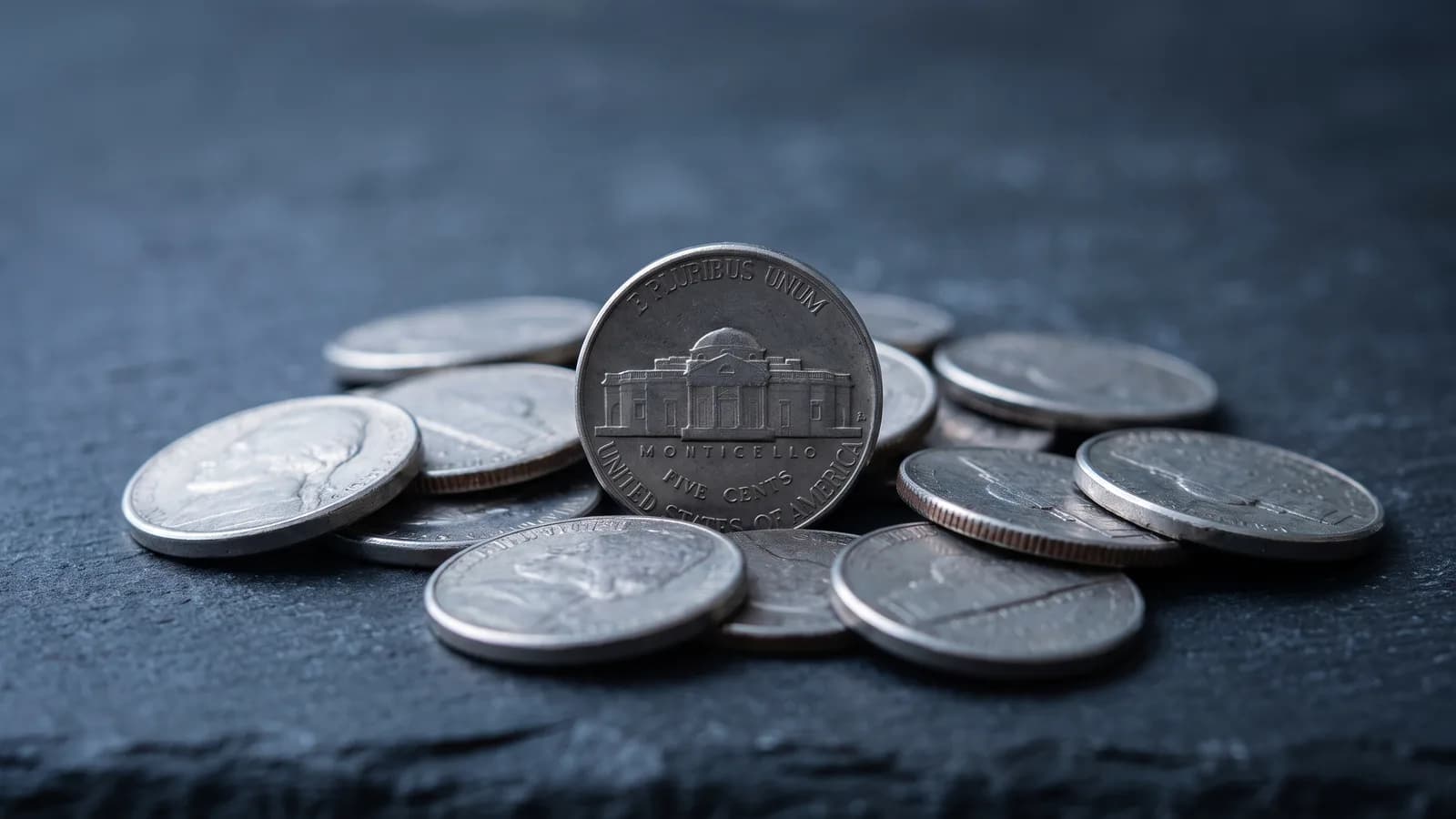
Almost every Jefferson nickel is worth five cents — they are made of copper-nickel, not silver — but the 1942 to 1945 'war nickels' are a real exception, because they contain silver. The series began in 1938 and still circulates today. This guide explains which Jefferson nickels contain silver and how to spot them, the key dates worth more than face, and what 'Full Steps' means to collectors.
Key takeaways
- Most Jefferson nickels are worth face value; they are copper-nickel, not silver, with one wartime exception.
- 1942–1945 'war nickels' are 35% silver and contain about 0.0563 troy ounces of silver each.
- You can spot a war nickel by the large mint mark (P, D, or S) above Monticello on the reverse.
- The 1950-D is the key date of the series, and early 1938–1939 branch-mint coins are semi-keys.
- Sharp 'Full Steps' coins, showing complete steps on Monticello, command a premium in high grade.
How much is a Jefferson nickel worth?
For most dates, five cents. Standard Jefferson nickels are 75% copper and 25% nickel with no precious metal, and they were made in huge numbers, so common coins are worth face value.
The exceptions are the wartime silver nickels, a handful of key dates, and sharply struck high-grade coins, all covered below.
What are wartime silver nickels?
From mid-1942 through 1945, nickel metal was needed for World War II, so the Mint changed the five-cent coin to an alloy of 56% copper, 35% silver, and 9% manganese. These 'war nickels' each contain about 0.0563 troy ounces of silver, which gives them a real premium over face value.
Standard composition resumed in 1946. The war nickels are the only Jefferson nickels with any silver, so they are the ones worth sorting out — see what U.S. coins are silver for the full silver picture.
How can you tell a war nickel?
Look for a large mint mark above Monticello on the reverse. To mark the silver alloy, the Mint placed a big P, D, or S over the dome of Monticello — and 1942 was the first time a 'P' for Philadelphia ever appeared on a U.S. coin.
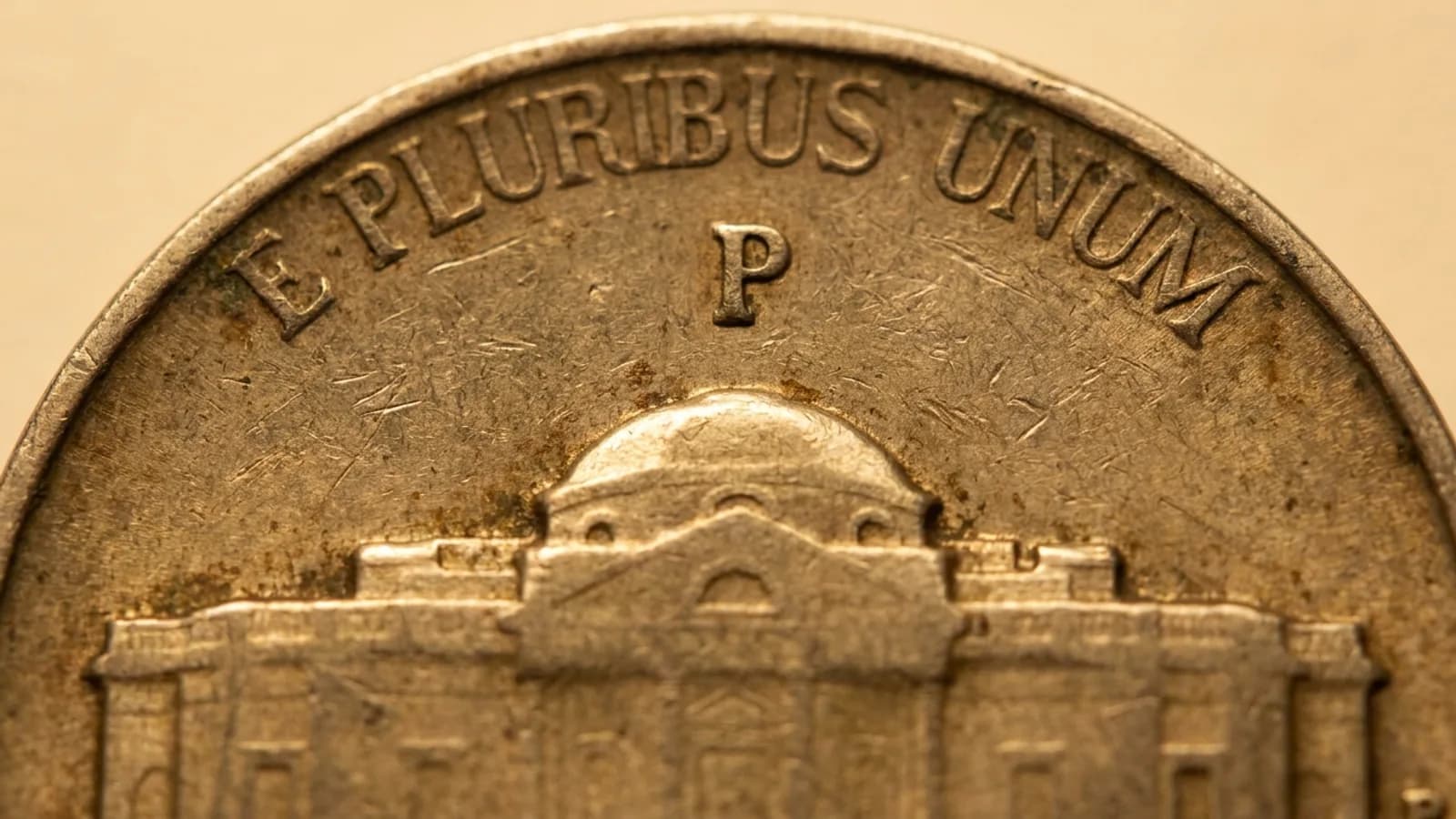
If a 1942–1945 nickel has that large mint mark over the dome, it is a 35% silver war nickel. A 1942 coin without it is the regular copper-nickel type.
What are the key dates?
The 1950-D is the key date of the series — a low-mintage coin that is scarce and valuable, especially in high grade. The early branch-mint coins (1938-D, 1938-S, 1939-D, 1939-S) are semi-keys worth more than common dates.
Collectors also chase varieties like the 1939 'Doubled Monticello.' The mint mark and date together define these — see what is a mint mark.
| Coin | Why it matters |
|---|---|
| 1942–1945 war nickels | 35% silver; large mint mark over Monticello |
| 1950-D | Key date; low mintage |
| 1938-D, 1938-S | Early semi-key dates |
| 1939-D, 1939-S | Scarcer early dates |
| Full Steps coins | Sharp strike; premium in high grade |
What are Full Steps nickels?
'Full Steps' (FS) describes a Jefferson nickel on which the steps of Monticello are fully and sharply struck. Because many coins show weak or incomplete steps, a Full Steps coin is scarcer and commands a premium in mint state.
Grading services note Full Steps on qualifying coins. For better coins, a trusted grade matters — see coin grading explained.
Where should you sell Jefferson nickels?
Sell war nickels to an established coin shop or gold and silver buyer based on their silver content; you can estimate it with the precious metals value calculator. For the 1950-D, Full Steps coins, and high grades, a rare coin dealer may pay a collector premium.
For the earlier five-cent design, see our buffalo nickel value guide. Compare offers on better coins and never clean them.
Frequently asked questions
Are Jefferson nickels silver?+
Only the 1942–1945 'war nickels,' which are 35% silver. All other Jefferson nickels are copper-nickel with no silver and are usually worth face value.
How can I tell if I have a silver war nickel?+
Look for a large mint mark (P, D, or S) above Monticello on the reverse of a 1942–1945 nickel. That large mark identifies the 35% silver alloy.
What is the key date Jefferson nickel?+
The 1950-D is the key date, scarce and valuable especially in high grade. The 1938 and 1939 branch-mint coins are semi-keys worth more than common dates.
What does Full Steps mean on a nickel?+
It means the steps of Monticello are completely and sharply struck. Full Steps coins are scarcer and carry a premium over the same grade without full steps.