
Medallic Washington and Musante's GW Numbers Explained
Medallic Washington by Neil Musante (Spink, 2016) is the modern standard reference for numismatic Washingtoniana, the large field of medals, tokens, and related pieces honoring George Washington. The two-volume set introduced a new GW numbering system that reworks and expands the long-used Baker numbers. This guide explains what the book covers, how the GW numbers work, and how to read a catalog citation such as Musante GW-72a, Baker-167.
Key takeaways
- Neil Musante's Medallic Washington (Spink, 2016) is the modern standard reference for numismatic Washingtoniana: two volumes, about 825 pages, and 1,148 fully illustrated listings.
- Its GW numbering system reworks and expands the older Baker numbers, which trace back to W.S. Baker's 1885 catalog of Washington medals.
- Listings are commonly cited with both systems, for example Musante GW-72a, Baker-167, so a reader can move between old and new references.
- Washingtoniana is the historic field of medals, tokens, and related pieces honoring George Washington, from 18th-century medals and inaugural buttons onward.
- Musante also wrote the standard catalog of John Adams Bolen's medallic work, linking two important exonumia references.
What Is Medallic Washington by Neil Musante?
Medallic Washington is a two-volume reference by Neil E. Musante, published by Spink in 2016, that catalogs the medals, tokens, and related pieces made to honor George Washington. It is widely treated as the modern standard reference for the field.
The set runs to roughly 825 pages across two volumes and lists 1,148 pieces, each illustrated in color on both sides with historical background. Its full title describes a catalog of struck, cast, and manufactured coins, tokens, and medals issued in commemoration of George Washington from 1777 to 1890, with Volume 1 covering 1777 to 1860 and Volume 2 covering 1861 to 1890.
Musante photographed pieces from major holdings, including the Appleton collection at the Massachusetts Historical Society, the Baker collection, and the Smithsonian, which is part of why the book became the go-to reference. Coin World covered the book's release in detail. For the wider hobby context, see our collecting medals guide.
What Is Washingtoniana?
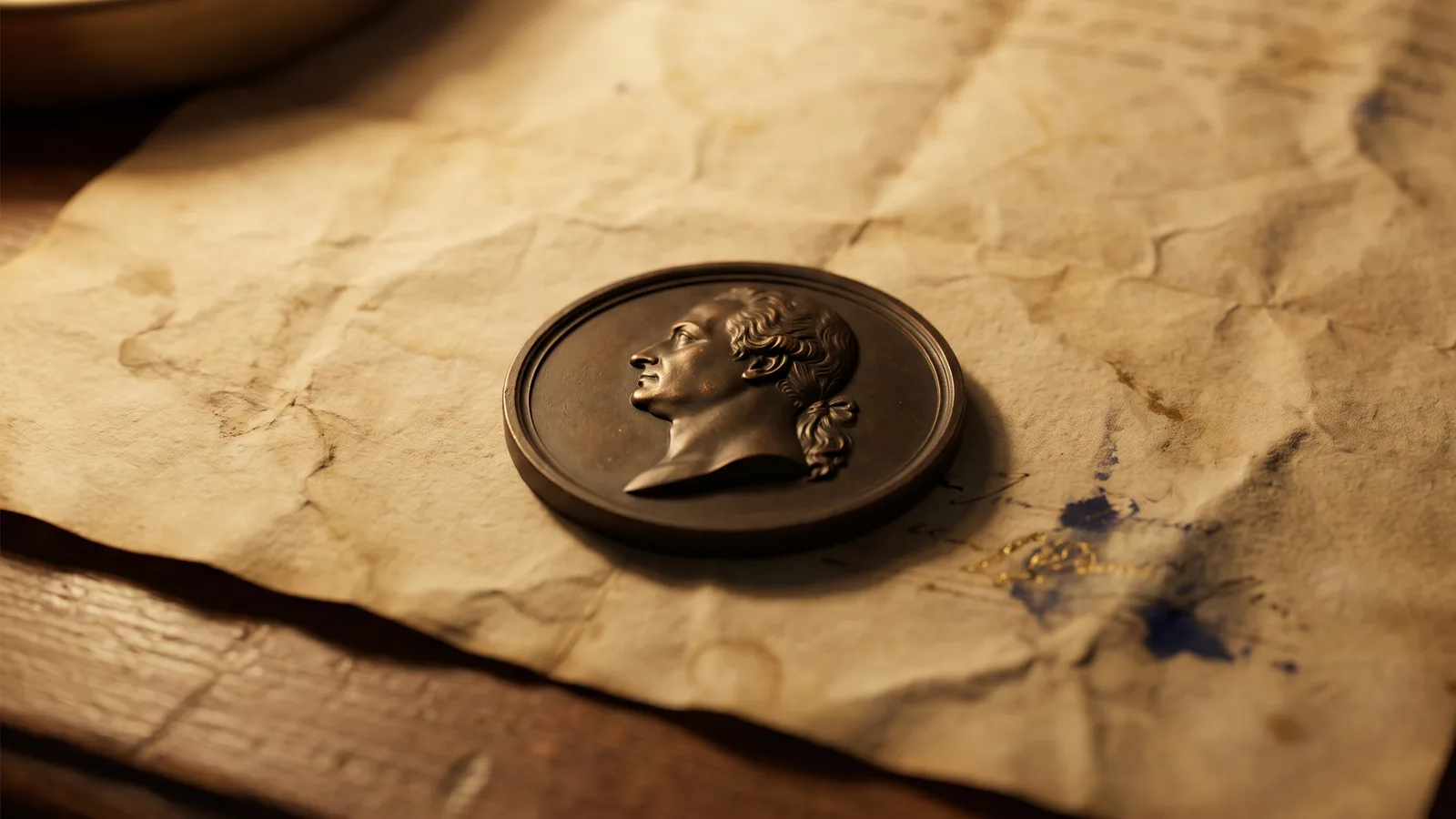
Washingtoniana is the historic collecting field of numismatic items that depict or honor George Washington. It spans medals, tokens, so-called dollars, buttons, and related pieces made from the 18th century onward.
Early anchors of the field include the Comitia Americana Washington Before Boston medal, the funeral medals struck around 1799 and 1800 after Washington's death, and the inaugural buttons worn by supporters at his first inauguration. Later pieces run through the 19th century and beyond, covering commemoratives, store cards, and exposition medals.
Because the field is so old and so large, it needed a single organizing catalog. That is the role Medallic Washington now fills, the way other references organize their own areas, such as so-called dollars or presidential campaign medals.
What Are Baker Numbers, and Where Did They Come From?
Baker numbers are the older cataloging system for Washington medals, named for William Spohn Baker, whose Medallic Portraits of Washington was published in 1885. For about 130 years, Baker numbers were the common shorthand for identifying a Washington piece.
Baker's system was later carried forward and updated in other references, including work associated with Russell Rulau and George Fuld. Over time, though, additions and revisions made the sequence harder to follow, since new discoveries did not always fit neatly into the original order.
Musante's book is a complete revision of Baker's catalog. Rather than discard the old numbers, it cross-references them, so a collector who knows a Baker number can still find the same piece.
How Does the GW Numbering System Work?
The GW system assigns each piece a number cited as Musante GW followed by the catalog number, for example Musante GW-72. Suffix letters such as a or b denote closely related varieties, so a listing may read Musante GW-72a.
Musante arranged the catalog to be more logical and chronological than the older sequence, which is why many collectors and dealers now lead with the GW number and add the Baker number in parentheses for continuity. A typical dealer or auction description shows both systems side by side.
This is the same idea behind other exonumia catalogs, where a single accepted number lets buyers, sellers, and appraisers describe the exact same variety without ambiguity.
| Element | What it means | Example |
|---|---|---|
| Musante GW-## | The modern GW catalog number from Medallic Washington | GW-72 |
| Suffix letter | A specific die or variety within that number | GW-72a |
| Baker-## | The older cross-referenced number from Baker's system | Baker-167 |
| Metal | The composition, which affects rarity and value | Bronze, silver, white metal |
| Grade or rarity note | Condition or scarcity as described by the seller or grader | AU, or noted as rare |
Why the New System Is Clearer
The GW system is clearer mainly because it is more consistent and more current. It brings the many known varieties into one illustrated, chronologically ordered catalog, which reduces guesswork when a piece does not exactly match a text description.
Full color photographs of both sides help too. Washington medals often exist in several close varieties, and a picture of the exact piece makes attribution far more reliable than a written description alone.
For collectors, that reliability matters at the point of sale. A shared, illustrated number lets a buyer and a rare coin dealer confirm they are discussing the same variety before money changes hands. Collector groups such as Medal Collectors of America publish research that supports this kind of careful attribution.
The Connection to John Adams Bolen
Neil Musante is also the author of the standard catalog of John Adams Bolen's medallic work, which ties two important exonumia references to the same researcher. Bolen was a 19th-century Springfield, Massachusetts die-sinker known for store cards, commemoratives, and struck copies of early American pieces.
Bolen's pieces are cited as Musante JAB numbers, the same author-plus-number convention used for Washingtoniana. Collectors who work in one area often encounter the other, since both sit within American exonumia.
If you collect maker-attributed medals, our John Adams Bolen guide covers his catalog and the JAB numbering in more detail.
How Washingtoniana Values Run
Washingtoniana values cover an unusually wide range. Common later medals and tokens can be affordable, often in the tens of dollars, while early rarities in strong grade can reach into the thousands and beyond at major auctions.
Metal, variety, condition, and provenance all move the number. A common variety in a common metal such as bronze sits at the low end, while a scarce early piece in silver, or one tied to a famous collection, sits far higher. Because ranges are so broad, treat any single figure as a starting point rather than a firm price.
The safest approach is to attribute the exact GW and Baker numbers first, then compare recent sales of that specific variety and grade. Digitized numismatic literature at the Newman Numismatic Portal can help with research. For high-value pieces, a formal opinion from a numismatic appraiser is worth the cost before you buy or sell.
How to Use the Reference When Buying or Selling
Start every Washington-medal purchase by pinning down the catalog number. Ask the seller for the Musante GW number, the cross-referenced Baker number, the metal, and clear photos of both sides, then compare them against the book or a trusted listing.
For selling, an accurate GW and Baker citation, plus honest condition notes, makes your piece far easier to price and to move. Vague descriptions invite lowball offers and disputes.
You can find shops that handle exonumia through the tokens and medals directory, and read the collecting medals guide for grading, storage, and authentication basics that apply to Washingtoniana as well.
Frequently asked questions
What is the standard reference for Washington medals?+
Neil Musante's Medallic Washington (Spink, 2016), a two-volume set of about 825 pages and 1,148 illustrated listings, is treated as the modern standard reference for numismatic Washingtoniana.
What does a citation like Musante GW-72a, Baker-167 mean?+
GW-72a is the modern Musante catalog number and variety letter for a specific Washington piece, and Baker-167 is the older cross-referenced number from the Baker system. Listing both lets readers move between references.
Are Baker numbers still used?+
Yes. Baker numbers, which trace to W.S. Baker's 1885 catalog, are still cited alongside the newer GW numbers so collectors familiar with the older system can identify the same piece.
Did Neil Musante write other catalogs?+
Yes. Musante also wrote the standard catalog of John Adams Bolen's medallic work, whose pieces are cited as Musante JAB numbers.
How much are Washington medals worth?+
Values range widely. Common later pieces can run in the tens of dollars, while early rarities in strong grade can reach the thousands. Attribute the exact variety and check recent sales before pricing.