
Flying Eagle Cent Value: Three Years, Two Business-Strike Dates
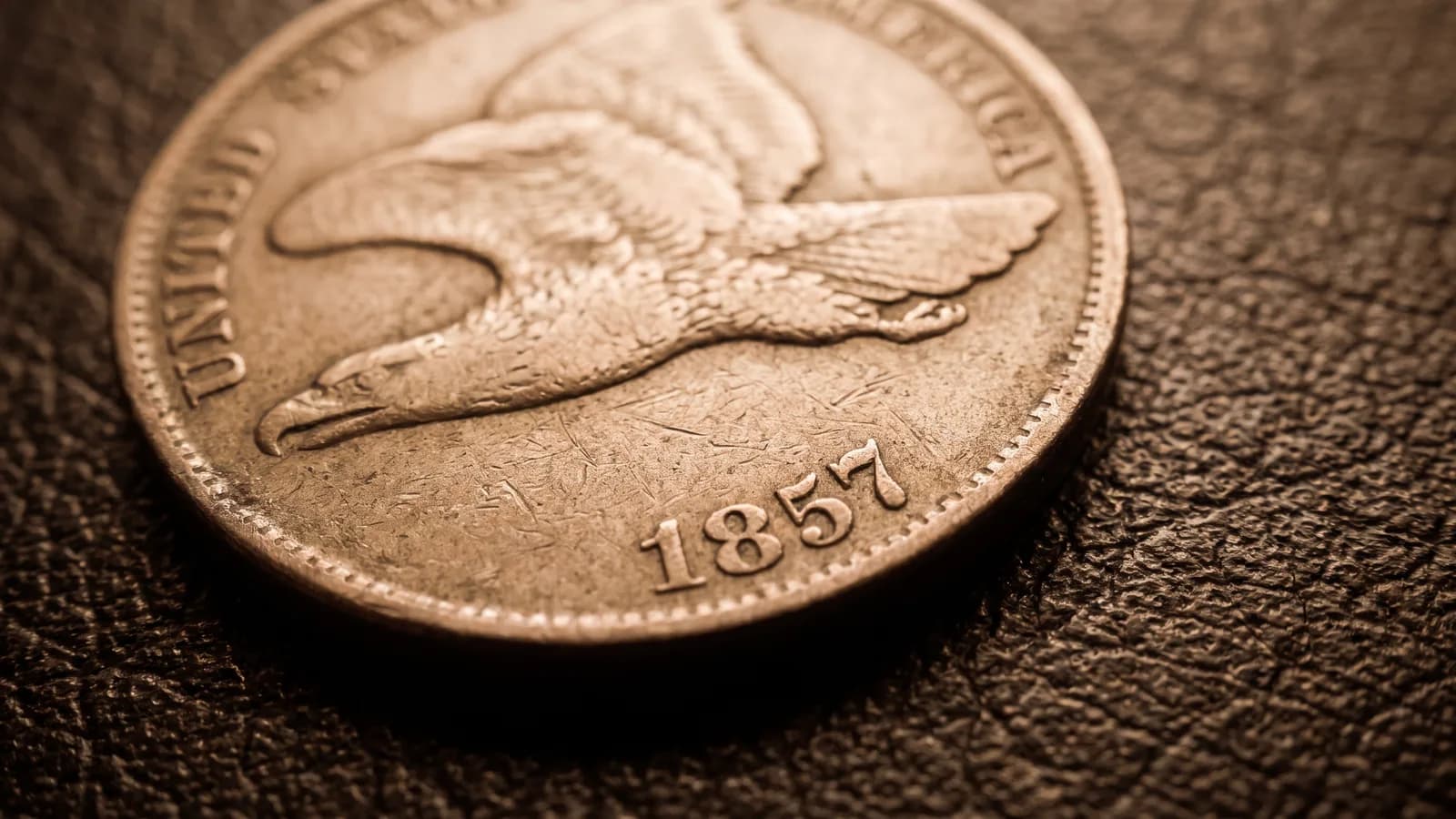
Flying Eagle cents were struck from 1856 to 1858 as the U.S. Mint's answer to the public's dislike of the large, heavy copper cent. The coin introduced the small-cent format that continues to this day. The 1856 is a proof or pattern issue sought by advanced collectors; the 1857 and 1858 are the business-strike dates, and circulated examples typically sell for $20 to $150 depending on date, variety, and condition.
Key takeaways
- Flying Eagle cents were struck from 1856 to 1858 as the first small-size U.S. cent, replacing the oversized large cent.
- The 1856 Flying Eagle cent is a pattern or proof issue — not a business strike — with around 1,500–2,000 pieces known.
- The 1857 and 1858 are the only business-strike dates; circulated examples typically sell for $20–$150.
- The 1858 comes in two varieties: Large Letters and Small Letters, distinguished by the size of the "AMERICA" lettering.
- All Flying Eagle cents are copper-nickel (88% copper, 12% nickel) with no silver content.
Why Was the Flying Eagle Cent Created?
By the mid-1850s, the large cent was widely seen as too heavy and cumbersome for everyday commerce. Congress authorized a new, smaller cent in 1857 — 19mm in diameter and composed of 88% copper and 12% nickel — that would be far more practical. The design, by James B. Longacre, showed a soaring eagle on the obverse and an agricultural wreath on the reverse.
The coin's short life (1856–1858) ended when the design proved difficult to strike cleanly in high relief. The U.S. Mint replaced it with the Indian Head cent in 1859, which remained in production through 1909.
What Is the 1856 Flying Eagle Cent?
The 1856 Flying Eagle cent occupies a unique category: it was struck before the coin's official authorization as a pattern or presentation piece, then re-struck in larger quantities later for sale to collectors. The population is estimated at 1,500–2,000 pieces. PCGS and NGC have certified examples, which in circulated grades sell for $5,000–$10,000 or more; Mint State examples bring significantly higher prices.
Because it was struck under unusual circumstances and is neither a pure proof nor a pure business strike, the 1856 is classified by PCGS and NGC as a proof. Any genuine 1856 should be certified by one of these services before purchase — the coin is frequently counterfeited and altered from later dates.
What Are 1857 and 1858 Flying Eagle Cents Worth?
The 1857 is the more common of the two business-strike dates, with a mintage of approximately 17.5 million. Circulated examples in Good (G-4) condition sell for $20–$35; Fine examples bring $40–$75; Very Fine pieces run $70–$125; Extremely Fine examples reach $125–$200. Mint State examples start around $250–$400 for MS-62.
The 1858 has two major varieties (discussed below). Common-date 1858 values are similar to 1857 in circulated grades. Sharp, problem-free examples of either date in Extra Fine or better are worth significantly more than average-quality pieces.
1858 Large Letters vs. Small Letters: Which Is Scarcer?
The 1858 flying eagle cent comes in two varieties distinguished by the lettering on the reverse: Large Letters ("AMERICA" with larger, bolder text) and Small Letters (narrower, more delicate lettering). Both varieties are common relative to the 1856 but are worth slightly different amounts — the Large Letters is generally somewhat more common, while the Small Letters is marginally more in demand among variety collectors.
Distinguish them by examining the letters in "AMERICA" under magnification. A reference photo or the PCGS CoinFacts database will confirm the variety quickly.
Strike Quality and Condition
Flying Eagle cents are notoriously difficult to strike fully — the high-relief eagle on the obverse and the wreath on the reverse competed for metal during striking, meaning a fully struck obverse often came at the cost of weak wreath detail and vice versa. A fully struck, problem-free Flying Eagle cent in Very Fine or better commands a significant premium over a typical example.
Look for full feather detail on the eagle's breast and clear leaf detail in the reverse wreath. Cleaned, spotted, or weakly struck examples sell at substantial discounts. A local coin dealer with 19th-century small-cent experience can assess strike quality in person.
Where to Find Flying Eagle Cents
Flying Eagle cents appear regularly at coin shows and in dealer inventory for reasonable prices. They are a popular series precisely because the complete business-strike set is only two dates (plus the 1856 proof for advanced collectors), making completion approachable.
Read coin grading explained to understand what grades give the best value for your budget. A nice Very Fine 1857 and 1858 Large Letters pair — both certified by PCGS or NGC — is an achievable two-coin set for $200–$400.
Frequently asked questions
Is the 1856 Flying Eagle cent a proof coin?+
It is classified as a proof by PCGS and NGC, though it was struck under unusual circumstances — as a pattern or presentation piece before the coin was officially authorized. Genuine 1856s are worth thousands of dollars in any condition.
How do I tell an authentic 1856 from an altered date?+
Always have a purported 1856 Flying Eagle cent certified by PCGS or NGC. Altered 1858 dates exist. Genuine 1856s show specific die characteristics that certification services verify.
Does the Flying Eagle cent have any silver or gold?+
No. Flying Eagle cents are 88% copper and 12% nickel with no precious metal content.
How many dates are in the Flying Eagle cent series?+
There are technically three dates (1856, 1857, 1858), but only 1857 and 1858 are business strikes. The 1858 has two major letter-size varieties. A complete business-strike set is just two (or three, counting varieties) coins.
What replaced the Flying Eagle cent?+
The Indian Head cent, introduced in 1859 and struck through 1909, replaced the Flying Eagle cent. It used the same small-cent format and composition (initially copper-nickel, then bronze from 1864).