
Civil War Store Cards by State: Where They Were Made
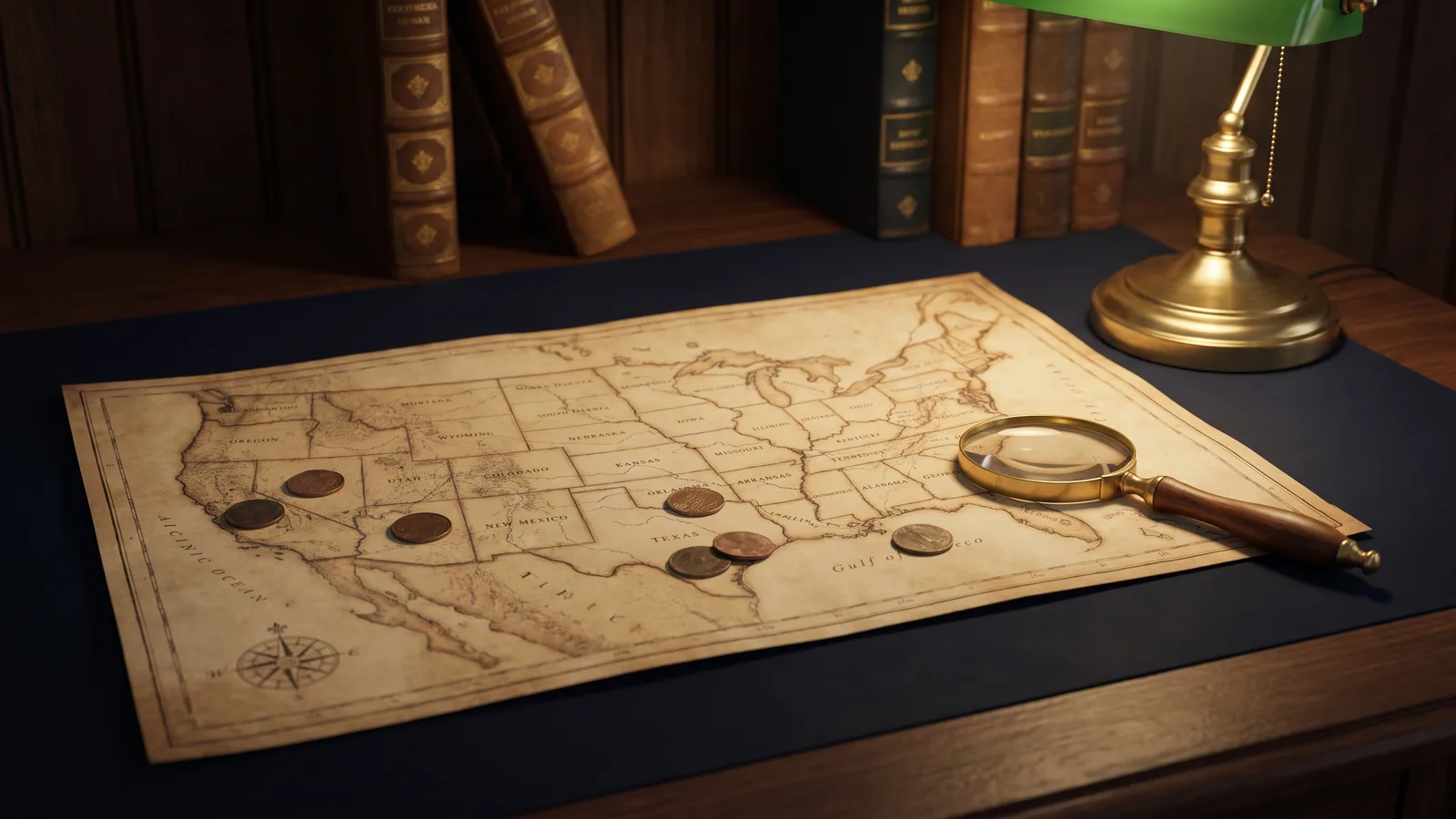
Civil War store cards by state break down along a simple line: they were issued almost entirely in Northern cities, and that geography still drives scarcity and value today. A store card is a Civil War token that advertises a private business, carrying a merchant name plus a city and state. New York leads by a wide margin, several Midwestern states follow, and Southern states are genuinely rare. If you want the full background on the series, start with our [pillar guide to Civil War tokens](/guides/civil-war-tokens-guide).
Key takeaways
- Civil War store cards were issued almost entirely in Northern cities, so the state of origin is one of the biggest factors in a token's scarcity and price.
- New York produced by far the most surviving store cards, especially New York City (Fuld city number 630); Ohio, Illinois, Michigan, Indiana, Wisconsin, and Pennsylvania are also well represented.
- Southern states rarely issued store cards, which makes the few that exist scarce and sought after.
- The Fuld store-card number encodes geography as STATE-CITYnumber-MERCHANT, so the number itself tells you where a token was made.
- Common New York merchant pieces stay modest in price, while scarce states and cities can run into the hundreds or more.
Where Were Civil War Store Cards Made?
Civil War store cards were made overwhelmingly in the North, because that is where the wartime coin shortage forced merchants to issue their own change. Store cards circulated informally at one cent from about 1861 to 1864, with most struck in 1863.
Private die-sinkers were concentrated in Northern cities, so the tokens they produced advertise businesses in states such as New York, Ohio, Illinois, Michigan, Indiana, Wisconsin, and Pennsylvania. The Confederacy had its own severe currency problems, but the private-token workaround did not take hold there in the same way.
The practical takeaway for collectors is that state of origin is not a footnote. It is one of the first things that separates a common token from a scarce one. For a broader look at the type itself, see our guide to Civil War store cards.
Why New York Dominates Surviving Store Cards
New York is by far the most common state for surviving Civil War store cards, and New York City accounts for a large share of that total. In the Fuld numbering system, New York City is city number 630, so many New York pieces carry an NY-630 prefix.
The reason is population and commerce. New York was the busiest commercial center in the wartime North, home to countless grocers, saloons, jewelers, and dry-goods merchants who needed small change and could afford custom advertising dies. More merchants ordering tokens meant more varieties struck and more pieces surviving into collector hands.
Because supply is deep, common New York merchant tokens tend to be among the most affordable store cards you can buy. That makes New York a natural starting point for a new collector who wants genuine wartime tokens without chasing rarities.
Which Other States Are Well Represented?
After New York, the Midwest supplies most surviving store cards, with Ohio, Illinois, Michigan, Indiana, and Wisconsin all well represented, along with Pennsylvania. These states had active manufacturing towns and enough merchant demand to keep die-sinkers busy.
Ohio in particular was an early and prolific source. The very first Civil War tokens are generally traced to Cincinnati in 1862, and Ohio merchants issued store cards in large numbers thereafter. Illinois and Michigan follow closely, with Chicago and Detroit contributing many varieties.
For collectors, this cluster of states offers a middle ground: more scarce and varied than New York, but still available enough that you can build a meaningful group without spending heavily. Learning to read a token's attribution helps here, and our guide on how to identify Civil War tokens walks through the markings.
Why Are Southern States So Rare?
Southern store cards are rare because the private-token phenomenon was almost entirely a Northern response to the coin shortage. Where a Southern merchant token does exist, it is usually scarce and can command a strong premium simply for its geography.
The Confederacy faced its own money problems, but it leaned on paper currency and did not develop the same network of Northern die-sinkers striking cent-sized advertising tokens. Border areas and a handful of Southern-leaning cities produced some pieces, but the surviving numbers are small.
That scarcity cuts both ways. It means a genuine Southern store card is a prize for a specialist, and it also means attribution and authenticity deserve extra care before you pay a rarity premium.
How the Fuld Number Encodes State and City
The Fuld store-card number is geographic: it reads STATE-CITYnumber-MERCHANT, so the number itself tells you where the token was made. The system was built by Melvin and George Fuld and is maintained by the Civil War Token Society.
Take NY-630-BD as an example. NY is the state, 630 is the city number for New York City, and BD identifies the merchant. A metal or die letter such as "a" (copper) may follow. Store-card numbering works differently from patriotic tokens, which use an obverse-die and reverse-die format like Fuld 207/409a rather than a geographic code.
Once you can parse the prefix, you can sort any store card by state and city at a glance, which is exactly how collectors organize the series.
Representative States: Common Versus Scarce
As a rule of thumb, New York and the major Midwestern states are the most available, while Southern states and thinly represented regions are the scarce end. The table below groups representative states by relative availability, with hedged value notes rather than invented counts.
| Group | Representative states | Availability and value note |
|---|---|---|
| Most common | New York (esp. NYC, city 630) | Deepest supply; common merchants stay modest in circulated grades |
| Well represented | Ohio, Illinois, Michigan, Indiana, Wisconsin, Pennsylvania | Widely collectible; scarcer cities and merchants cost more |
| Scarce | Most Southern states and thinly issued areas | Few survive; genuine pieces often run into the hundreds or more |
How State and City Scarcity Affects Price
Geography can swing a store card's price as much as its grade does. Common New York merchant tokens in circulated condition are usually modest, while scarce states, scarce cities, and popular merchants push prices into the hundreds and beyond.
Rarity is tracked on the Fuld and CWTS scale from R-1 (more than 5,000 known) down to R-10 (unique). A common R-1 or R-2 New York piece and a very scarce R-6 Southern piece can look similar in hand yet differ enormously in price. A single attribution letter can move a token from modest to serious money, which is why careful identification matters.
Condition still counts. Because most store cards are copper, third-party graders such as PCGS apply color designations of brown, red-brown, and red, with full red commanding the largest premiums. To find dealers who can appraise or sell a piece, browse our tokens and medals directory or the wider network of local coin shops.
Building a State or City Set
The most popular way to collect store cards is by geography, and home-state collecting is a favorite entry point. Assembling tokens from the state or city where you live gives the series a personal thread and a natural stopping point.
A common approach is to start with an affordable New York or Midwestern piece to learn the type, then branch into your home state, and finally chase one or two scarcer cities as budget allows. Some collectors aim for one token per state, while others go deep on a single city.
Whatever the plan, buy the token and the attribution together, and lean on references and dealers rather than guesswork. For a step-by-step approach to the hobby, see our guide on how to collect Civil War tokens, and read more series background at Wikipedia's Civil War token entry.
Frequently asked questions
Which state has the most Civil War store cards?+
New York, by a wide margin. New York City (Fuld city number 630) alone accounts for a large share of surviving store cards because it was the busiest commercial center in the wartime North.
Why are Southern store cards so rare?+
The private-token response to the coin shortage was almost entirely a Northern phenomenon. Southern merchants issued very few cent-sized advertising tokens, so the pieces that do exist are scarce and often command a premium.
How do I tell what state a store card is from?+
Read the Fuld number. Store cards use a geographic format, STATE-CITYnumber-MERCHANT, so the prefix (for example NY-630 for New York City) identifies the state and city directly.
Are common store cards expensive?+
Not usually. Common New York and Midwestern merchant tokens in circulated grades tend to stay modest, while scarce states, scarce cities, and popular merchants run into the hundreds or more.
Is home-state collecting a good way to start?+
Yes. Collecting tokens from your own state or city is one of the most popular approaches. It keeps the set focused, adds a personal connection, and gives you clear goals as you learn the series.