
American Gold Buffalo Guide: The U.S. Mint's Purest Gold Coin
The American Gold Buffalo, introduced by the U.S. Mint in 2006, is the first .9999 fine (24-karat) gold coin in U.S. history. It was created in response to demand from buyers — particularly international and Asian markets — who prefer the purity standard of the Canadian Gold Maple Leaf over the American Gold Eagle's 22-karat alloy. The coin carries a $50 face value, contains exactly 1 troy ounce of gold, and is struck in one-ounce, half-ounce, quarter-ounce, and tenth-ounce sizes.
Key takeaways
- The American Gold Buffalo (.9999 fine, 1 troy oz) is the first 24-karat gold coin struck by the U.S. Mint, introduced in 2006.
- The design reproduces James Earle Fraser's iconic Buffalo nickel (1913), with a Native American portrait on the obverse and a bison on the reverse.
- New coins typically carry premiums of $80–$150 over gold spot; secondary-market examples are slightly lower.
- The Gold Buffalo is legal tender at $50 face value but contains $3,000+ in gold at current prices.
- The Gold Buffalo differs from the American Gold Eagle: the Eagle is .9167 fine (22-karat); the Buffalo is .9999 fine (24-karat).
The Buffalo Nickel Design, Reimagined in Gold
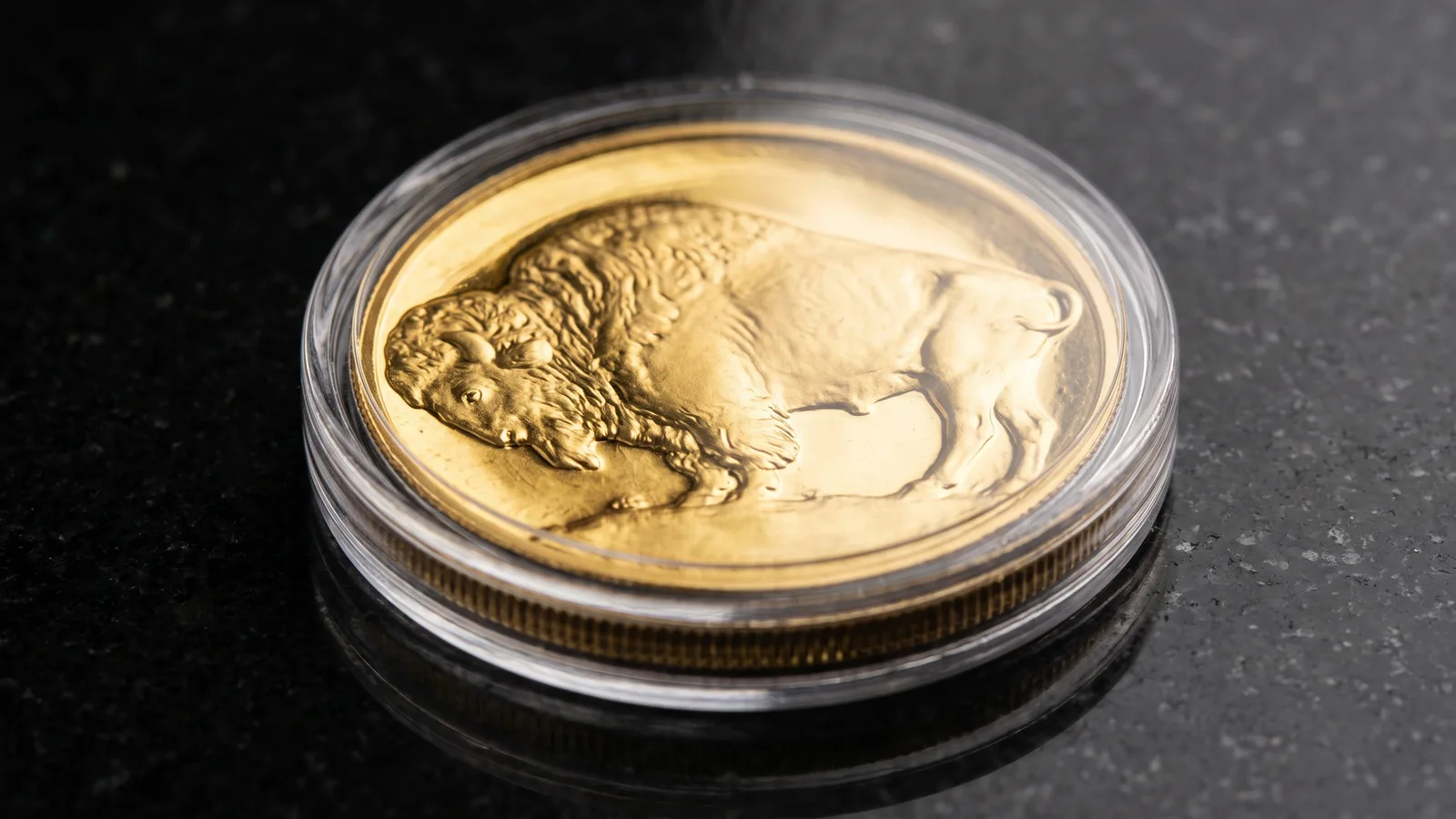
The Gold Buffalo reproduces James Earle Fraser's classic Buffalo nickel design, which originally appeared on the 5-cent piece from 1913 to 1938. The obverse shows a composite portrait of a Native American man (Fraser said he used three chiefs as models); the reverse shows an American bison (the model was Black Diamond, a bison at the Central Park Zoo). The design is considered one of the most artistically successful in U.S. coinage history.
Using the Buffalo nickel design was a deliberate choice — the Mint wanted an unmistakably American image for its pure-gold flagship coin. The result is a coin that resonates with both numismatists and bullion buyers.
Gold Buffalo vs. Gold Eagle: Key Differences
The two flagship U.S. gold coins differ significantly in purity. The American Gold Eagle is 22-karat (.9167 fine) — alloyed with copper and silver for durability. The American Gold Buffalo is 24-karat (.9999 fine) — essentially pure gold. Both contain exactly 1 troy ounce of fine gold; the Gold Eagle simply weighs more because of the alloy.
Which to buy depends on preference. The Gold Eagle is more scratch-resistant due to the alloy and is arguably more liquid with a longer track record (1986-present vs. 2006). The Gold Buffalo appeals to buyers who want maximum purity and the "pure gold" designation. Premiums are often similar; check current dealer prices to compare.
| Feature | Gold Buffalo | Gold Eagle |
|---|---|---|
| Purity | .9999 fine (24k) | .9167 fine (22k) |
| Fine gold per 1 oz coin | 1.000 troy oz | 1.000 troy oz |
| Total weight (1 oz) | 1.000 troy oz | 1.0909 troy oz |
| First year | 2006 | 1986 |
| Design | Buffalo nickel (Fraser) | Walking Liberty / Eagle |
| Durability | Softer (pure gold) | Harder (alloyed) |
What Do Gold Buffalos Cost?
The price of a Gold Buffalo moves with the gold spot price — the coin always contains exactly 1 troy ounce of fine gold. New coins from the U.S. Mint or authorized dealers typically carry premiums of $80–$150 per coin over spot for the one-ounce size. Secondary-market (previously purchased) examples are available for $30–$80 over spot from coin dealers and bullion dealers.
Fractional sizes (half, quarter, and tenth ounce) carry proportionally higher premiums per ounce because the minting and distribution costs are spread over less gold. Use our precious metals calculator to see today's melt value for any Gold Buffalo size.
Proof Gold Buffalos: The Collector Version
The U.S. Mint releases proof versions of the Gold Buffalo annually through its direct-to-public sales program. Proof Gold Buffalos have mirror-bright fields, frosted devices, and higher premiums than bullion-finish examples — typically $200–$500 above spot for recent years. They are sought by collectors for their finish quality and annual presentation.
Early-year proof Gold Buffalos (especially 2006-W and 2008-W) have maintained strong secondary-market demand. The 2008-W Reverse Proof, issued in a limited four-coin set, is particularly sought and commands premiums well above melt.
How to Buy and Sell Gold Buffalos
Gold Buffalos are among the most liquid gold coins in the U.S. market. Any reputable coin dealer or bullion dealer will buy them. For bullion-finish examples, expect to receive spot plus $20–$60 when selling. For proof versions, dealers who handle numismatic gold will offer more reflective of the collector premium.
Avoid buying Gold Buffalos from non-specialist venues (online auctions, general dealers) where counterfeit risks exist — sophisticated fakes of this coin have been documented. Buy from an authorized U.S. Mint network dealer or a reputable local coin shop. PCGS- or NGC-certified examples are the safest buy for collectors paying premium prices.
Frequently asked questions
Is the American Gold Buffalo the same as the American Gold Eagle?+
No. Both contain 1 troy ounce of fine gold, but the Buffalo is .9999 fine (24-karat pure gold) while the Eagle is .9167 fine (22-karat, alloyed for durability). The Buffalo weighs exactly 1 troy oz; the Eagle weighs slightly more due to the alloy.
What is the face value of a Gold Buffalo?+
The legal tender face value is $50, but the coin's gold content makes it worth many times that at current prices. No one spends Gold Buffalos at face value.
Can I put a Gold Buffalo in an IRA?+
Yes. The American Gold Buffalo meets IRS requirements for inclusion in a gold IRA (Individual Retirement Account) because it is .9999 fine. Consult a financial advisor or IRA custodian for specifics on how to add gold to a retirement account.
How do I know if my Gold Buffalo is real?+
Buy from reputable dealers only. Counterfeits exist. For any coin you're unsure about, a professional dealer with a Sigma or Precious Metal Verifier tool can test it quickly. PCGS or NGC certification provides definitive authentication.
Are older Gold Buffalos worth more than newer ones?+
In bullion finish, no — all contain the same gold. In proof or special finishes, early years (especially 2006-W and 2008-W Reverse Proof) have numismatic premiums. Proof 2008-W sets in particular are actively collected and worth checking current auction records.