
How to Read a Coin: A Guide to Coin Anatomy and Terminology
Every coin has a standardized vocabulary — a set of precise terms for each part of the coin's anatomy. Knowing these terms lets you read a grading report, follow a numismatic discussion, describe a coin accurately to a dealer, and identify key features that affect value. This guide covers the essential coin anatomy vocabulary from obverse to edge, along with how each part relates to grading and identification.
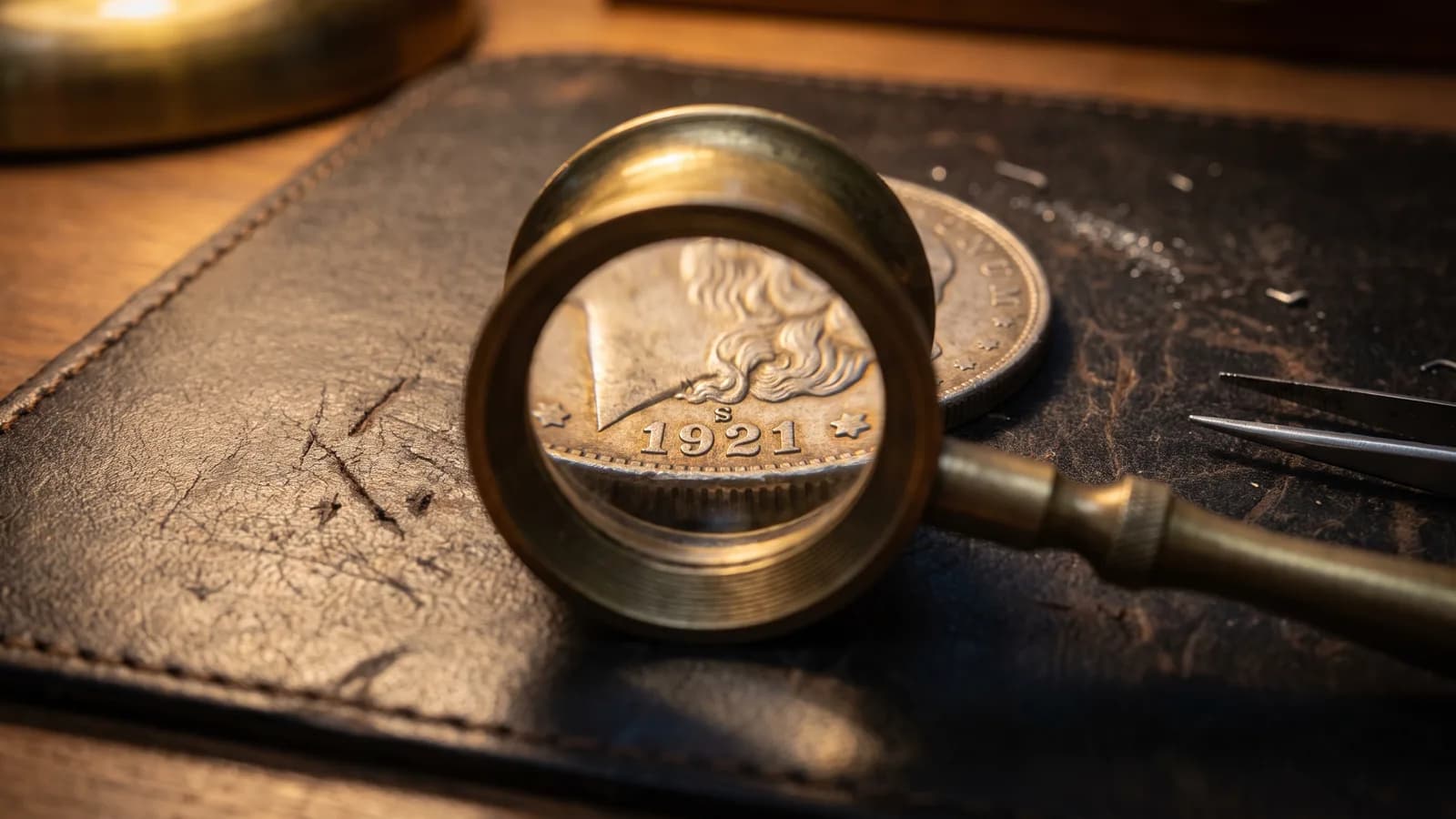
Key takeaways
- The obverse is the front (typically the portrait side); the reverse is the back. Both matter for grading.
- The field is the flat, open background area; the relief (or device) is the raised design element. Field imperfections grade harder than device imperfections.
- The legend is the primary inscription ("UNITED STATES OF AMERICA"); the motto is a secondary phrase ("E PLURIBUS UNUM," "IN GOD WE TRUST").
- The edge is the third side of a coin — reeded (ridged), plain (smooth), or lettered — and is an important identification feature.
- The mintmark tells you which U.S. Mint facility struck the coin: P (Philadelphia), D (Denver), S (San Francisco), O (New Orleans), CC (Carson City), W (West Point).
Obverse and Reverse: Front and Back
The obverse is conventionally the "heads" side — the primary face of the coin, typically carrying the portrait or main design. On U.S. coins, the obverse carries a portrait (Lincoln, Washington, Franklin, etc.) or a symbolic figure (Walking Liberty, Seated Liberty).
The reverse is the "tails" side — the secondary face, usually carrying the denomination, the national emblem, or a thematic design. On the Lincoln cent, the reverse shows wheat ears (Wheat Penny) or the Lincoln Memorial. Both obverse and reverse are graded separately in some grading contexts, and either can carry the mintmark.
Field and Relief: Background vs. Design
The field is the flat, open background area on either side of the coin — the surface between and around the design elements. On proof coins, the field is mirror-bright; on business strikes, it has satiny luster. Contact marks (bag marks, hits) in the field affect grade more than the same-sized marks on a design element.
The relief refers to the raised design elements — portraits, eagles, lettering, devices — that stand above the field. Design elements in higher relief (standing further from the field) are more visually dramatic but also more susceptible to wear at the high points. The difference between a coin in Very Fine and Extremely Fine grade often comes down to how much detail remains on the high points of the relief.
Legend, Motto, and Date
The legend is the primary inscription around the coin — on U.S. coins, typically "UNITED STATES OF AMERICA" and the denomination. The motto is a secondary phrase: "E PLURIBUS UNUM" (Out of Many, One) appears on most U.S. coins; "IN GOD WE TRUST" has appeared on U.S. coins since 1864 and on all U.S. coins by law since 1938.
The date is always a critical identification element — combined with the mintmark, it uniquely identifies most U.S. coins. On some coins the date is in the obverse field; on others (like the Buffalo nickel) it is on the rim or in the exergue.
Exergue, Rim, and Edge
The exergue is the horizontal band at the bottom of the reverse (and sometimes obverse), often separated from the main design by a line. It typically contains the date or a secondary inscription. PLURIBUS UNUM often appears in the exergue on early coins.
The rim is the raised outer edge of both faces — the border that protects the design from wear. A flat or worn rim is a significant grading detriment. The edge is the third face of the coin — the narrow outer surface. The edge can be reeded (ridged, like a dime or quarter), plain (smooth, like a cent or nickel), or lettered (inscribed, like the Presidential dollars with edge lettering).
Mintmarks: Where Was Your Coin Made?
The mintmark identifies which U.S. Mint facility struck the coin. Current and historical marks include: P (Philadelphia, used on most coins after 1980; not used on cents), D (Denver), S (San Francisco — proofs and historical circulation), O (New Orleans, 1838–1909), CC (Carson City, 1870–1893), W (West Point — special and bullion coins), C (Charlotte, 1838–1861), and D for Dahlonega (1838–1861, only on gold).
Mintmark location varies by coin series and era. On Morgan dollars, the mintmark is on the reverse below the eagle. On Lincoln cents, it is on the obverse (after 1968) or reverse (1909–1967). Always check the specific coin type's reference for mintmark location.
Luster, Strike, and Eye Appeal
Luster is the sheen created by metal flow during the minting process — the cartwheel or rolling brightness visible when you tilt a Mint State coin. Undisturbed original luster is a primary indicator of a coin's state of preservation. Strike refers to how fully the design details were transferred from the die to the coin — a weak strike leaves shallow detail on the high points even on an otherwise well-preserved coin.
Eye appeal is the overall visual impression — a combination of luster, strike, surfaces, and toning. Two coins can share the same numerical grade but look dramatically different; the one with better eye appeal brings more money. Understanding these concepts helps you evaluate coins beyond just their grade number.
Frequently asked questions
What is the difference between the rim and the edge of a coin?+
The rim is the raised border on the front and back faces of the coin. The edge is the thin outer surface connecting the two faces — the part you see when you look at a coin from the side. The edge can be reeded, plain, or lettered.
What does "high relief" mean on a coin?+
High relief means the design elements stand significantly above the field. Coins like the 1907 Saint-Gaudens High Relief double eagle have dramatic three-dimensional sculpture that required multiple strikes to produce. High-relief designs are visually striking but difficult to mass-produce.
Why does a mark in the field grade worse than a mark on a device?+
The field is the open background where marks are immediately visible and distracting. A mark on Lincoln's ear on a Lincoln cent, for example, is partially hidden in the design; the same-size mark in the open field beside the portrait is far more obvious. Grading services treat field marks as more serious than device marks.
What does it mean when a coin has "lettered edge"?+
A lettered edge has inscriptions applied during or after minting on the edge surface. The U.S. Presidential dollar coins (2007–2016) have "E PLURIBUS UNUM," "IN GOD WE TRUST," the year, and mintmark on the edge rather than on the faces. Some early U.S. coins also had lettered edges.
Where is the mintmark on a Lincoln cent?+
From 1909 to 1941, the mintmark was on the reverse below the wheat ears (or, for the 1909-S VDB, on the reverse below the VDB initials). From 1942 to 1967, it was on the reverse. From 1968 to present, it is on the obverse to the right of Lincoln's portrait.