
Large Cents and Half Cents: A Guide to America's First Copper Coins
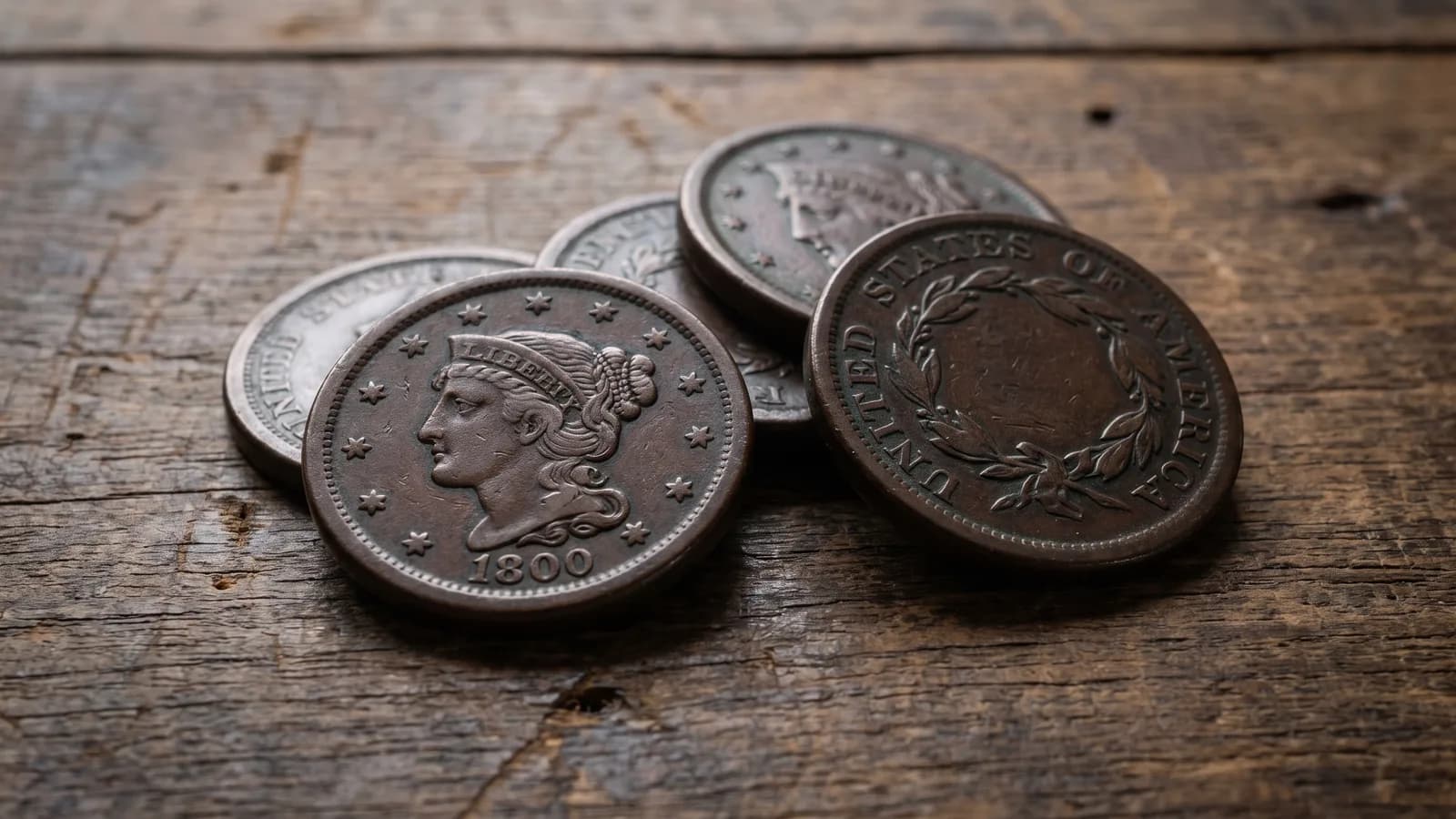
Large cents and half cents were America's first copper coins, struck continuously from 1793 to 1857. The large cent — slightly larger than today's quarter — evolved through six design types over 64 years, while the half cent has the distinction of being the lowest-denomination coin ever regularly issued by the U.S. Mint. Common circulated large cents from the later types are affordable collectibles; early types, key dates, and the 1793 issues are among the most prized coins in American numismatics.
Key takeaways
- Large cents were struck from 1793 to 1857 across six major design types; half cents ran concurrently from 1793 to 1857.
- The 1793 Chain cent — the very first regular-issue U.S. cent — is one of the most historic and valuable coins in American numismatics.
- Common dates of the Braided Hair large cent (1839–1857) in circulated grades sell for $25–$80.
- Half cents of all types are scarcer than large cents and command higher premiums for the same condition.
- Original, uncleaned brown surfaces are essential for maximum value — cleaned copper loses much of its premium.
Why Were Large Cents Discontinued in 1857?
The large cent was practical in 1793, when copper was cheap and the coin's intrinsic metal value was close to its face value. By the 1850s, rising copper prices and the inconvenient size of the coin prompted Congress to authorize a smaller, lighter cent — the Flying Eagle cent — in 1857. The old large cents were withdrawn from circulation, and millions were melted.
The half cent was discontinued simultaneously, partly because the denomination was seen as impractical at a time when inflation had made a half-cent purchase almost meaningless.
Large Cent Design Types and What They Are Worth
Flowing Hair / Chain cent (1793): The first design, showing a chain of 15 links on the reverse — a symbol of unity. Only one year of production; circulated examples start at $1,000+ and climb steeply with grade. Flowing Hair / Wreath cent (1793): Same year, revised design with a wreath replacing the chain; similar value range. Liberty Cap (1793–1796): Common circulated examples in G-4 range from $150 to $400.
Draped Bust (1796–1807): Circulated examples of common dates run $40–$150 in Good-Fine grades. Classic Head (1808–1814): Common dates in Good-Fine condition sell for $50–$125. Coronet / Matron Head (1816–1835) and Braided Hair (1839–1857): The most available types; common circulated examples sell for $20–$80.
Half Cent Design Types and Values
Half cents mirror the large cent's design evolution: Flowing Hair (1793), Liberty Cap (1794–1797), Draped Bust (1800–1808), Classic Head (1809–1836), and Braided Hair (1840–1857). As a general rule, half cents command 30–60% more than large cents of the same type and condition, reflecting lower mintages and collector demand for the smallest denomination.
Common Braided Hair half cents in Very Good to Fine condition sell for $80–$175. The early types in any circulated grade start at several hundred dollars. Several years have no regular-issue dates: 1798, 1799, 1801 (partially), and others — making a complete date set a serious long-term challenge.
The 1793 Chain Cent: America's First Coin
The Chain cent of 1793 was the first coin regularly struck for circulation by the United States Mint. It carries the motto "AMERI." (abbreviated for AMERICA, a space-saving choice that drew criticism at the time) and the reverse chain — which some contemporaries found more appropriate for a prison than a republic. The design was quickly replaced by the Wreath cent.
Genuine 1793 Chain cents in any condition are worth thousands of dollars. Circulated examples in Good condition sell for $5,000–$15,000 depending on strike and surfaces; higher-grade examples bring far more. Authentication by PCGS or NGC is essential — counterfeits and altered dates exist.
Key Dates and Scarce Varieties
Beyond the 1793 issues, standout rarities include the 1799 large cent (very low mintage, $500+ in Good), the 1804 large cent (a major rarity, $1,000+ even in heavily worn condition), and the 1811 large cent (scarce in all grades). Among half cents, the 1796 No Pole (missing the Liberty cap pole) and the various no-date issues of the 1830s are high-demand rarities.
Die varieties are a major aspect of early copper collecting. Specialist references like the Sheldon book (large cents) and Cohen (half cents) catalog hundreds of die marriages. Many collectors focus on variety collecting rather than date collecting in these series.
Condition and Surfaces: The Key to Large Cent Values
Copper coins are especially sensitive to environmental damage. Verdigris (green corrosion), cleaning, and harsh polishing are common on 19th-century copper and dramatically reduce value. Original, uncleaned examples with natural brown or chocolate patina command strong premiums. "Bright red" or gleaming copper on a 150-year-old coin is almost always a sign of cleaning.
Buy certified coins from PCGS or NGC for any large cent or half cent where you plan to spend more than $100. For common Braided Hair dates under $50, a trusted local dealer or coin show is the right venue.
Where to Find and How to Sell Large Cents
Large cents and half cents are available at most coin shows and from dealers who specialize in U.S. colonial and early American coins. Finding problem-free examples in Fine or better condition requires patience — the series has been heavily searched for 150 years.
Selling is straightforward for common Braided Hair dates: any reputable coin dealer knows the market. For early types, key dates, or anything potentially valuable, get an appraisal from a numismatic appraiser first and consider a major auction house for specimens above Fine.
Frequently asked questions
Are large cents made of pure copper?+
Large cents are nearly pure copper — the composition was adjusted slightly over the series but was approximately 98–100% copper. They contain no silver or gold.
What is the most valuable large cent?+
The 1793 Chain cent and 1799 large cent are among the most valuable. High-grade 1793 Chain cents have sold for $250,000 or more at major auctions. Even a circulated example is worth thousands.
Why are half cents harder to find than large cents?+
Half cents were struck in smaller quantities than large cents across most years, and the low denomination meant they were considered inconvenient and many were melted or lost. Today they are genuinely scarcer than large cents of comparable types.
How do I tell if my large cent has been cleaned?+
Original copper coins from this era will show natural brown, chocolate, or reddish-brown toning. Bright copper or stripped, uniform surfaces suggest cleaning, which significantly reduces value.
Can I sell a large cent to a local coin dealer?+
Yes, for common Braided Hair dates. For anything earlier than 1816 or any coin you suspect may be a key date or variety, get an independent appraisal first — early copper specialist knowledge is required to price these accurately.