
Two-Cent Piece Value: The Coin That First Said "In God We Trust"
The two-cent piece was struck from 1864 to 1873 and earned a permanent place in numismatic history as the first U.S. coin to carry the motto "In God We Trust." Most circulated examples are affordable — common dates in Good to Fine condition typically sell for $15 to $50 — while key dates and Mint State survivors can bring several hundred dollars or more.
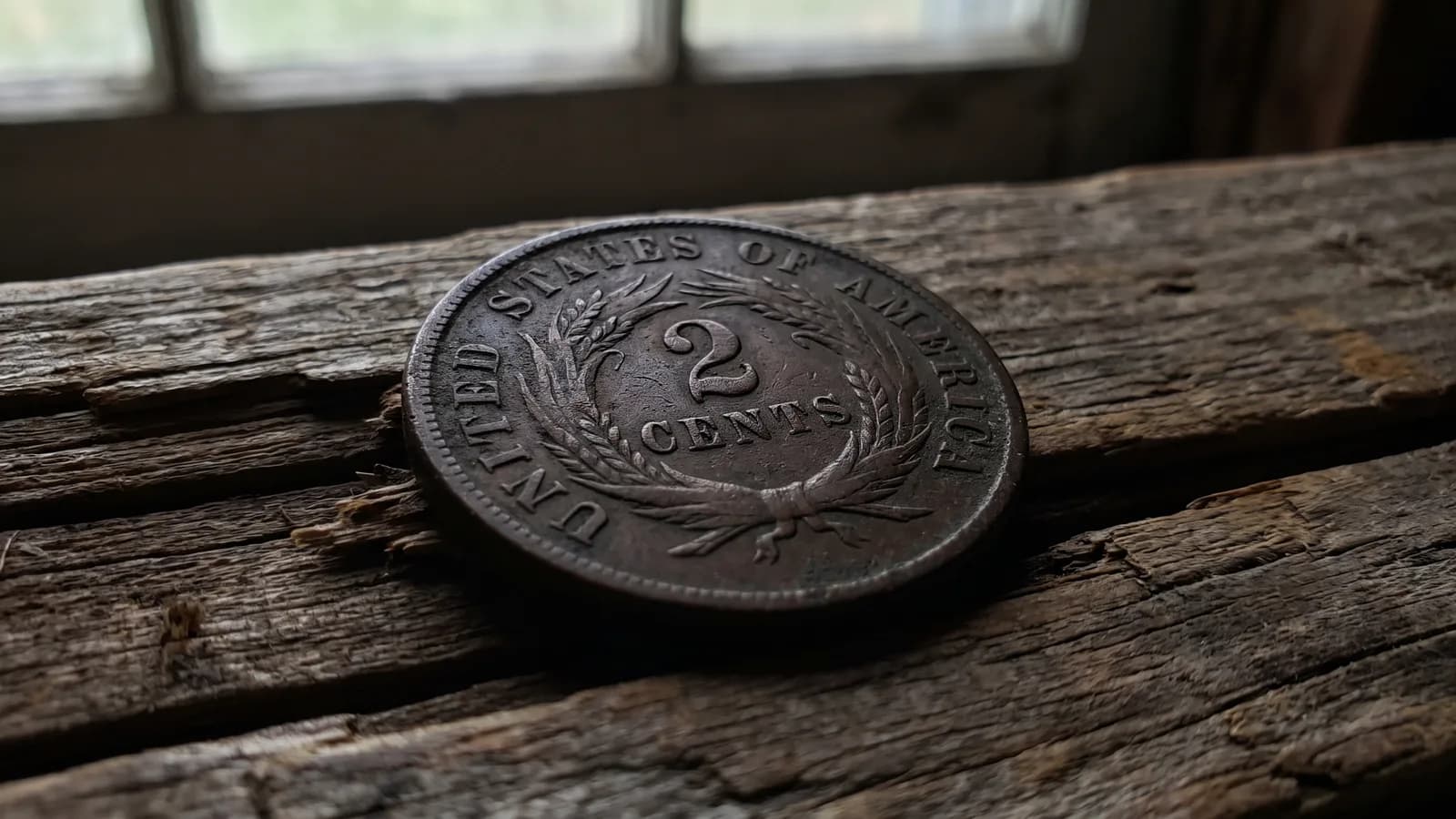
Key takeaways
- The two-cent piece (1864–1873) was the first U.S. coin to bear the motto "In God We Trust."
- Circulated examples in Good-to-Fine condition typically sell for $15–$50.
- The 1873 two-cent piece was proof-only; no business strikes exist for that year.
- The 1864 Small Motto variety is the scarcest business strike in the series and worth two to four times the Large Motto at the same grade.
- Original, uncleaned surfaces add significant value — a cleaned coin can lose 50% or more of its market value.
What Is the Two-Cent Piece and Why Was It Made?
The two-cent piece is a large bronze coin (95% copper, 4% tin, 1% zinc) introduced in 1864 during a severe Civil War coin shortage. Hoarding had driven silver and even copper coins out of circulation, leaving merchants using privately issued tokens as substitutes.
The coin was designed by James B. Longacre, the U.S. Mint's chief engraver. Its most significant feature was the obverse shield motto — "IN GOD WE TRUST" — which Congress authorized that year. The motto went on to appear on all U.S. coins.
What Are Two-Cent Pieces Worth Today?
Common-date two-cent pieces in Good (G-4) condition typically sell for $15–$30. Fine (F-12) examples run $25–$50, and Very Fine pieces bring $50–$120. Extremely Fine (EF-40) examples of common dates range from $100 to $200, and Mint State pieces (MS-63) start around $150–$350. The bronze composition has essentially no melt value — these are collected purely for numismatic interest.
Coin values shift with collector demand; consult a local coin dealer or a current price guide for the latest figures.
The 1864 Small Motto: What Makes It the Key Date?
The 1864 issue comes in two varieties created by a mid-year die change: Large Motto and Small Motto. On the Small Motto, the letters in "IN GOD WE TRUST" are thinner and more compressed; on the Large Motto, they are bolder. The Small Motto was struck from fewer dies and is significantly scarcer.
In circulated grades the Small Motto commands two to four times the Large Motto equivalent. Use a 5× or 10× loupe and a reference photo to distinguish them — the letter thickness is clear once you know what to look for.
Proof-Only 1873 and Other Key Dates
The 1871 and 1872 have lower mintages — roughly 721,000 and 65,000 respectively — making them noticeably scarcer than earlier dates in any grade above Fine. The 1873 is the series' great rarity: the Mint struck only proof pieces that year (approximately 1,100 produced), and no business strikes were made. Any 1873 two-cent piece should be authenticated by PCGS or NGC before purchase.
Proof two-cent pieces exist for all years 1864–1873 and represent a separate collecting path. They are identifiable by mirror-bright fields and sharply squared rims.
How Original Surfaces Affect What Your Coin Is Worth
Bronze coins from the 1860s suffer easily from spots, verdigris (green corrosion), and cleaning. A cleaned or environmentally damaged two-cent piece can be worth 50–70% less than a problem-free example at the same technical grade. Original, uncleaned examples with natural brown or red-brown surfaces command the strongest prices.
PCGS- and NGC-graded coins carrying a "details" notation (Cleaned, Corrosion) trade at steep discounts. If you own an original-surface example, emphasize that quality when selling.
Should You Collect Two-Cent Pieces?
The two-cent piece is one of the most completable 19th-century series — just nine business-strike dates plus the proof-only 1873 and one notable variety. A circulated set from 1864 Large Motto through 1872 is achievable for $300–$600, depending on grades. Adding a 1864 Small Motto and an 1873 proof raises the budget significantly but completes the series.
Find problem-free examples at coin shows or through a reputable coin dealer. Read coin grading explained before buying to know what grade to look for at your budget.
Frequently asked questions
Is the two-cent piece made of silver?+
No. Two-cent pieces are bronze (95% copper, 4% tin, 1% zinc) and contain no silver. Melt value is negligible — they are collected for numismatic value only.
How do I tell the 1864 Small Motto from the Large Motto?+
Look at the letters in "IN GOD WE TRUST" on the obverse shield. Small Motto lettering is thinner and more compact; Large Motto letters are bolder and wider. A loupe and reference photo confirm it quickly.
Is any 1873 two-cent piece automatically a proof?+
Yes. No business strikes were made in 1873. The Mint produced approximately 1,100 proof pieces only. Verify by checking for mirrored fields and sharply squared rims, then get it certified before buying or selling.
Where is the best place to sell a two-cent piece?+
PCGS- or NGC-certified examples sell well at major auction houses. Raw, problem-free coins are best appraised in person by a [local coin dealer](/coin-shops) who can evaluate surfaces and eye appeal.
What is the most valuable two-cent piece?+
The 1873 proof in high grades (PR-65 or above) and the 1864 Small Motto in Mint State are the most valuable. Exceptional examples of either have brought thousands of dollars at auction.