
Coin Grading Explained: The 70-Point Scale
Coin grading is how the hobby measures a coin's condition, and it is the single biggest factor in what a collectible coin is worth after rarity. Coins are graded on the 70-point Sheldon scale, from a barely identifiable Poor coin up to a flawless 70, and a difference of a few grades can multiply a coin's value many times over. This guide explains the scale, what every grade abbreviation means, how professional grading by PCGS and NGC works, and when paying to grade a coin is worth it.
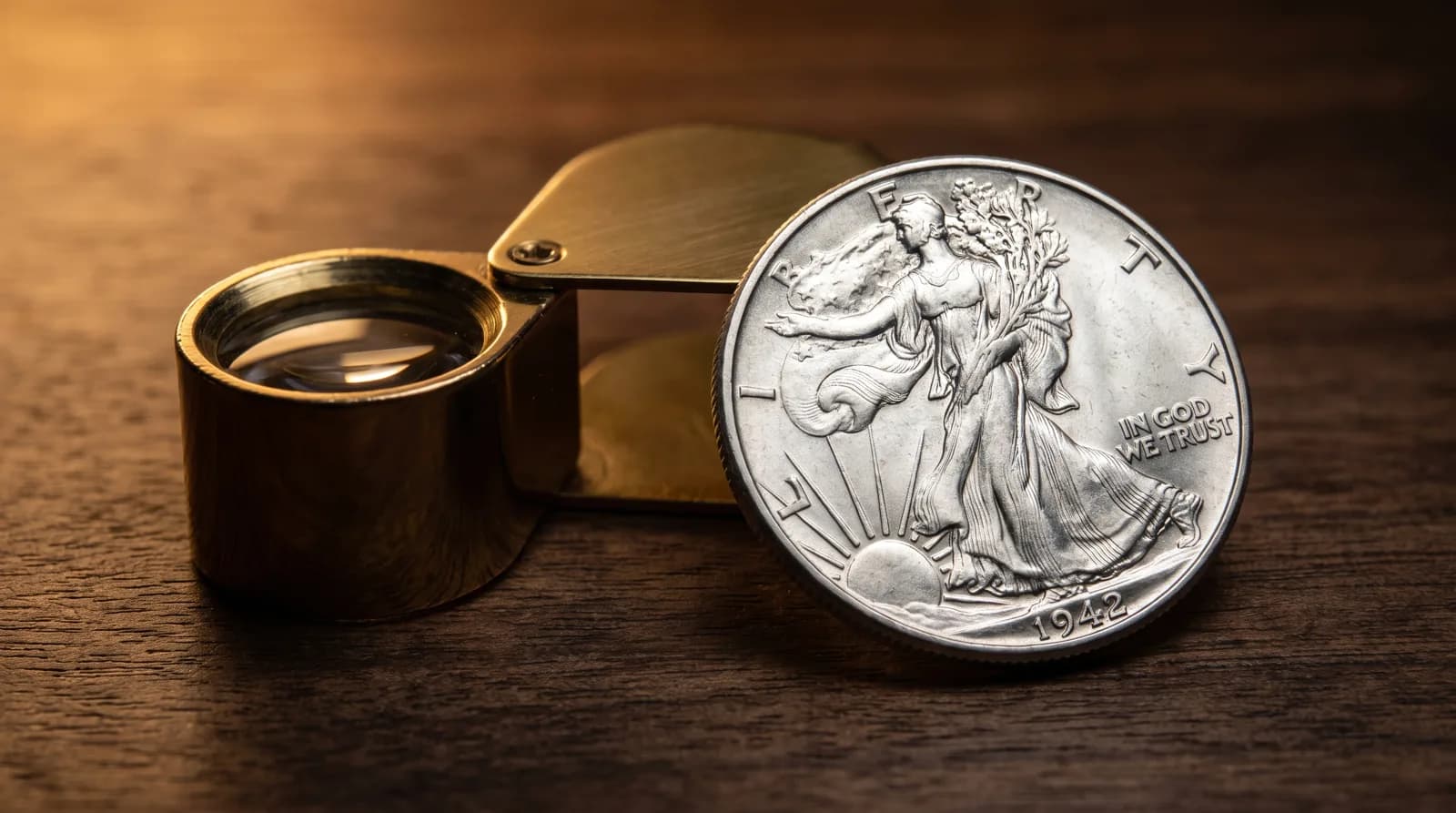
Key takeaways
- Coin grading rates a coin's condition on the 70-point Sheldon scale, from Poor (P-1) to a flawless Mint State or Proof 70.
- Grade often matters more than the date: the same coin can be worth a few dollars worn and thousands in high mint state.
- PCGS and NGC are the two grading services the market trusts; they assign a grade and seal the coin in a tamper-evident holder, or 'slab.'
- Grading costs a per-coin fee plus shipping and insurance, so it only pays off on coins whose certified value clears that cost.
- Never clean a coin before grading — cleaning leaves fine scratches that lower the grade and the value.
What is coin grading?
Coin grading is the assessment of a coin's condition on a standard scale, expressed as a number from 1 to 70 with a letter prefix. It gives buyers and sellers a shared language for condition, so a coin described as 'MS-65' means the same thing to a dealer in Florida as it does to one in Oregon.
Grade reflects wear, surface marks, luster, strike quality, and eye appeal. It is not the same as rarity — a common coin can grade very high, and a rare coin can grade low — but for two examples of the same issue, grade is usually what separates a modest coin from a valuable one. See what your coins are worth for how grade fits alongside date, metal, and rarity.
What is the Sheldon grading scale?
The Sheldon scale is a 70-point system that ranks coins from 1 (Poor) to 70 (perfect). It was devised by Dr. William Sheldon in 1949 for early large cents and later adopted across U.S. numismatics, so today every series is graded the same way.
The numbers are not evenly spaced in value — the jump from a worn coin to a mint-state one can be enormous, while two adjacent mint-state grades can also differ sharply in price. The American Numismatic Association publishes the standards most graders follow.
What do the grade abbreviations mean?
Each grade pairs a number with a letter prefix that describes the broad condition band. Circulated coins run from P (Poor) up to AU (About Uncirculated, 50–58); uncirculated coins are Mint State (MS) 60–70; proof coins use PR or PF. The table below maps the common ones.
| Grade | Abbreviation | Condition in plain English |
|---|---|---|
| Poor / Fair | P-1 / FR-2 | Barely identifiable; heavy wear |
| About Good / Good | AG-3 / G-4-6 | Very worn, but date and type readable |
| Very Good / Fine | VG-8 / F-12-15 | Worn, with major details clear |
| Very Fine / Extremely Fine | VF-20-35 / EF(XF)-40-45 | Light to moderate wear, sharp detail |
| About Uncirculated | AU-50-58 | Trace wear on the highest points only |
| Mint State | MS-60-70 | No wear; 60 is marked, 70 is flawless |
| Proof | PR / PF-60-70 | Special collector strike, mirror finish |
What's the difference between circulated and mint state?
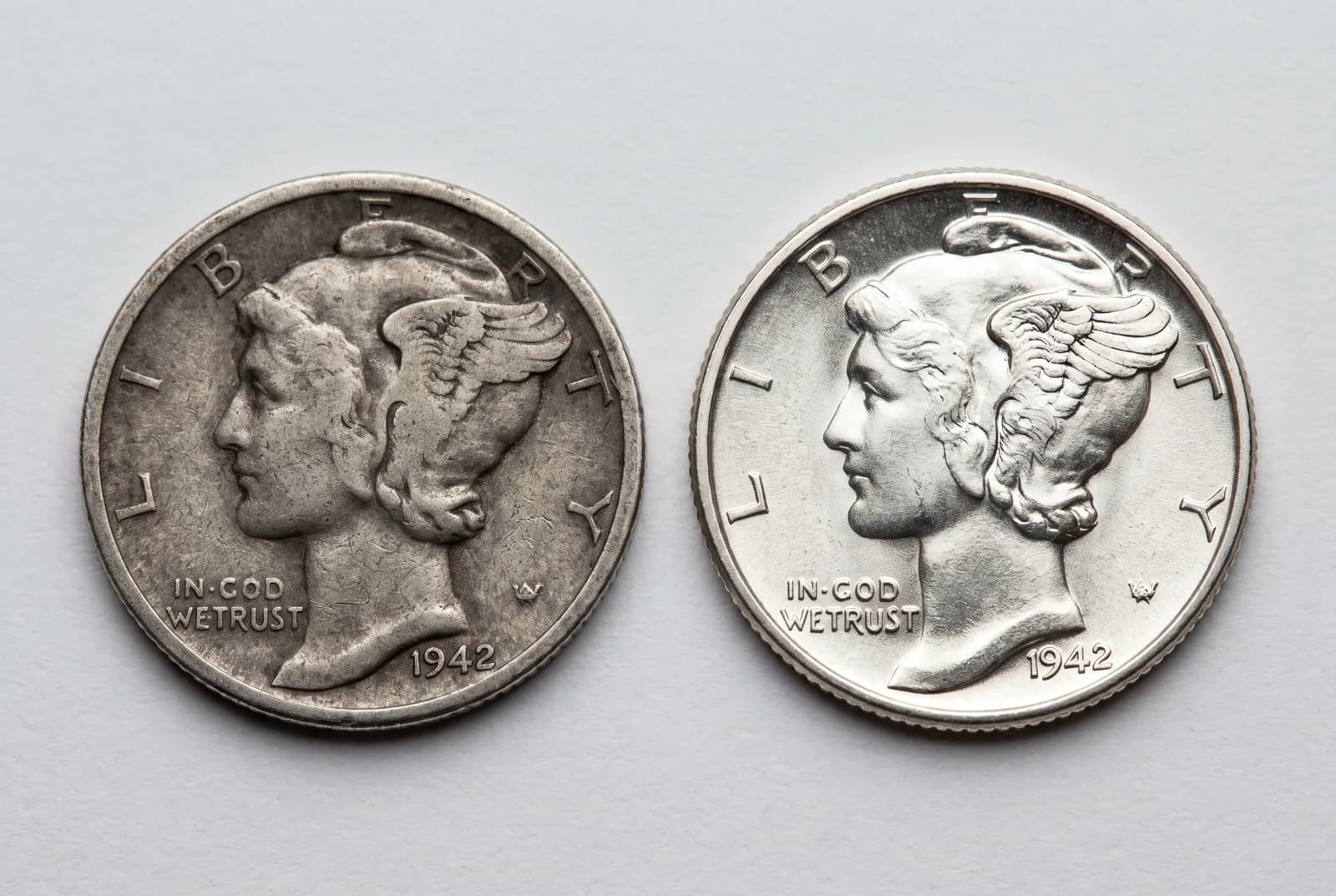
A circulated coin shows wear from handling and use; a mint-state coin has never circulated and shows no wear, only the marks it may have picked up at the mint. That line — any wear at all versus none — is the most important boundary on the whole scale.
Luster, the original mint shine, is the giveaway: mint-state coins keep their full cartwheel luster, while even lightly circulated coins lose it on the high points. The gap in price across that line is often where the real money sits, which is why the AU-58 versus MS-60 distinction gets so much attention.
How much does grade affect a coin's value?
Grade can change a coin's value by orders of magnitude. Because higher-grade survivors are scarcer, demand concentrates at the top of the scale, so each grade step up can mean a large price jump rather than a small one.
As a worked example, take a common-date Morgan silver dollar. In a circulated grade it may be worth little more than its silver content. The same date in MS-63 can be worth several times that, and in MS-65 or higher it can climb into the hundreds — same coin, same year, separated only by condition. Our Morgan silver dollar value guide shows how that plays out date by date.
What are PCGS and NGC?
PCGS (Professional Coin Grading Service) and NGC (Numismatic Guaranty Company) are the two third-party grading services the U.S. market trusts most. They independently authenticate and grade a coin, then seal it in a tamper-evident plastic holder — a 'slab' — labeled with the grade.
Their grade carries weight because it is consistent and backed by a guarantee, so a certified coin sells faster and closer to full value than a raw (ungraded) one. When a coin is in a PCGS or NGC slab, buyers are largely paying for the number on the label.
How does professional grading work?
You submit a coin to PCGS or NGC — directly as a member or through an authorized dealer — and pay a per-coin fee based on the coin's value and how fast you want it back. The service authenticates it, multiple graders assign a grade, and it comes back encapsulated.
Many local shops handle submissions for customers, which is the easiest route for most people. A numismatic appraiser or rare coin dealer can tell you whether a coin is worth submitting and prepare it correctly.
What do the extra labels like RD, FB, and + mean?
Beyond the number, graders add designations that capture special quality. These can lift value meaningfully, so they are worth knowing.
Common ones include color codes on copper — RD (red), RB (red-brown), and BN (brown) — and strike designations like FB (Full Bands) on Mercury dimes or FS (Full Steps) on Jefferson nickels. A '+' or a star (NGC) marks a coin at the high end of its grade or with exceptional eye appeal. They reward originality and strike, which is one more reason never to clean a coin.
Should I get my coin graded?
Grade a coin only when the certified value clearly beats the cost of grading. Each submission carries a per-coin fee plus shipping and insurance both ways, so low-value coins rarely justify it.
A simple test: grading tends to pay off on scarcer or higher-grade coins worth comfortably more than the total fee, on coins where authenticity is in question, and on anything you plan to sell to a wider market. For a common circulated coin worth a few dollars, raw is fine. See how coin appraisals work if you mainly need a documented value rather than a slab.
| Situation | Grade it? | Why |
|---|---|---|
| Scarce or high-grade coin worth well above the fee | Yes | Certification adds value and liquidity |
| Authenticity is in doubt | Yes | A slab confirms it is genuine |
| Common circulated coin worth a few dollars | No | Fees would exceed any gain |
| Bulk bullion held for metal | No | Valued on metal, not grade |
How do I grade a coin myself?
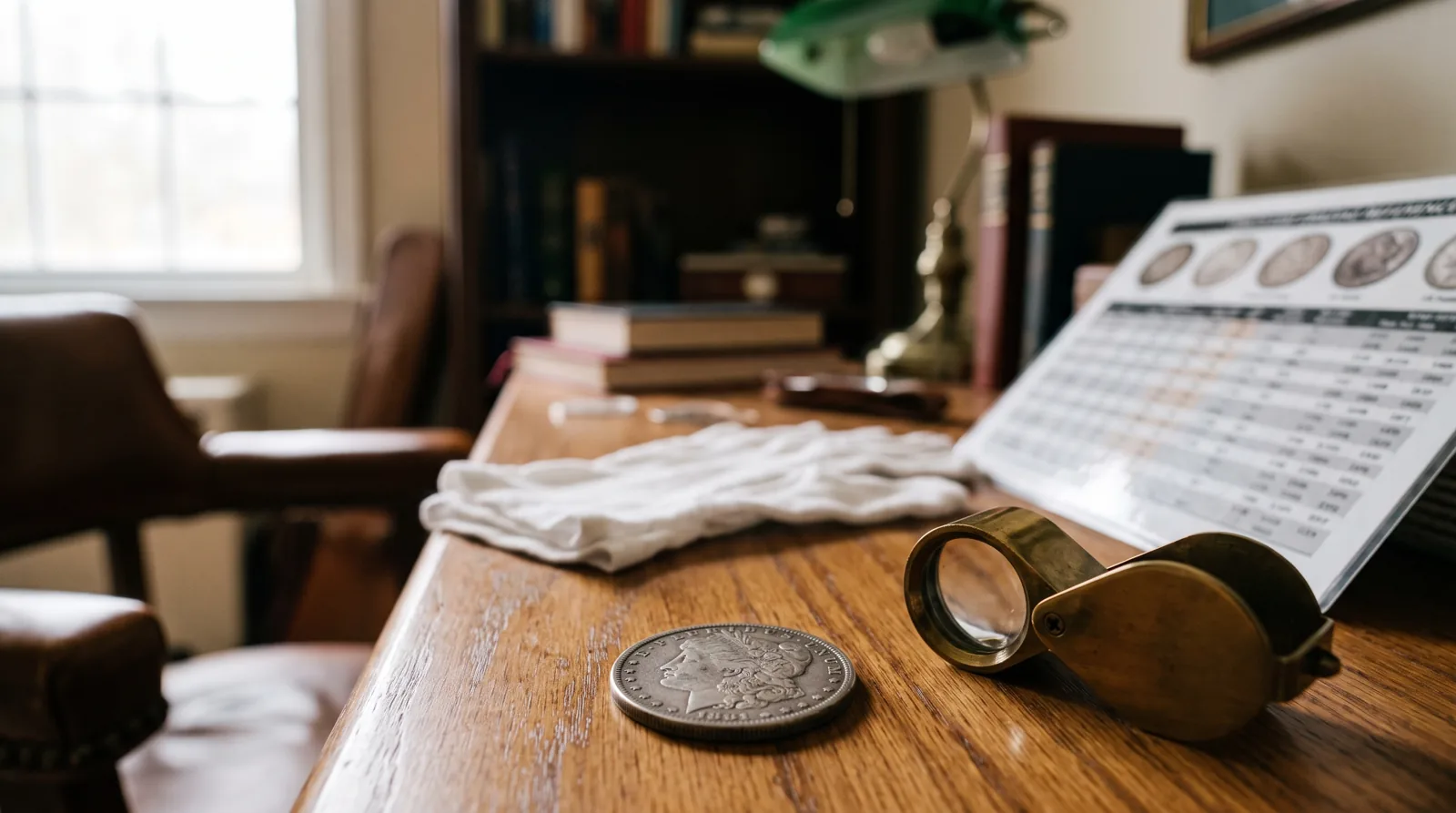
You can estimate a grade at home with good light, a magnifier, and a reference, but treat it as a rough guide rather than the final word. Hold the coin by its edges, tilt it under a single light source, and check the highest points for wear and the surfaces for the original luster.
Compare against published photo standards from PCGS or the ANA for that exact series — grading is series-specific, and a 'Fine' Buffalo nickel does not look like a 'Fine' Lincoln cent. For any coin you think is valuable, get a second opinion at a local coin shop before you rely on your own grade.
Why you should never clean a coin
Cleaning a coin almost always lowers its grade and its value. Even gentle wiping leaves microscopic hairline scratches and strips the original surface, and graders detect it instantly — a cleaned coin is often labeled 'cleaned' or returned without a numeric grade.
The toning and patina that build up over decades are usually desirable, not dirt. Leave every coin exactly as you found it and let a professional assess it; a cleaned example of a valuable coin can sell for a fraction of an untouched one.
What does the slab actually protect?
The holder does two jobs: it certifies the grade and it preserves the coin. A genuine PCGS or NGC slab is sealed, serial-numbered, and verifiable on the grader's website, which both proves the coin is authentic and protects it from handling and the environment.
Because counterfeit slabs exist, always verify the certification number with the grading service before paying a premium for a certified coin. Our guide on how to spot fake coins covers checking slabs along with the coins themselves.
Frequently asked questions
What is the highest coin grade?+
MS-70 for mint-state coins and PR-70 (or PF-70) for proofs — a flawless coin with no defects visible at 5x magnification. Most coins never reach it; MS-70 is most common on modern bullion and proof issues.
What's the difference between PCGS and NGC?+
Both are top-tier third-party grading services whose grades the market trusts. They differ in label style and some abbreviations (PCGS uses PR for proofs, NGC uses PF), but for most collectors a coin in either holder sells close to full value.
How much does it cost to grade a coin?+
A per-coin fee that scales with the coin's value and turnaround speed, plus shipping and insurance both ways. Because of that, grading only makes sense when the certified coin is worth comfortably more than the total cost.
Does cleaning a coin lower its grade?+
Yes. Cleaning leaves fine scratches and removes original surface, and graders detect it. A cleaned coin is typically downgraded or returned without a numeric grade, and sells for far less than an original example.
Can I grade a coin myself?+
You can estimate a grade at home with a loupe and a series-specific reference, but it's only a rough guide. For coins you believe are valuable, get a professional opinion or submit to PCGS or NGC for a grade the market trusts.