
Coin Errors Explained: Doubled Dies, Off-Center Strikes, and More
A coin error is a mistake that happens during the minting process, and some errors are worth far more than the coin's face value. The catch is that most 'errors' people find are actually ordinary damage that happened after the coin left the mint, which carries no premium. This guide explains the main types of genuine coin errors, what makes them valuable, and how to tell a real error from damage before you get your hopes up.
Key takeaways
- A coin error is a mistake made during minting — not damage that happens after a coin leaves the mint.
- The most valuable, popular errors include dramatic doubled dies and major off-center strikes.
- Errors are different from varieties (intentional die differences) and from post-mint damage, which has no premium.
- Value depends on how dramatic and visible the error is, how rare it is, and how popular the coin series is.
- Because errors are widely faked or confused with damage, valuable ones should be authenticated by PCGS or NGC.
What is a coin error?
A coin error is a flaw created at the mint — during the making of the die, the preparation of the blank, or the striking of the coin. Genuine errors are scarce because mints work hard to catch them, which is what gives the dramatic ones value.
An error is not the same as a variety, which is a repeatable, often intentional difference between dies, and it is definitely not the same as post-mint damage (PMD) — dents, scratches, and corrosion that happen after a coin enters circulation.
What is a doubled die?
A doubled die happens when the design is impressed onto the die more than once at slightly different angles, so every coin struck by that die shows doubling in the lettering or date. The famous 1955 and 1972 Lincoln cent doubled dies are classic examples.
True doubled dies show doubling with notching and separation in the design itself. They should not be confused with 'machine doubling,' a flat, shelf-like doubling that is common and carries no premium.
What are off-center and broadstrike errors?
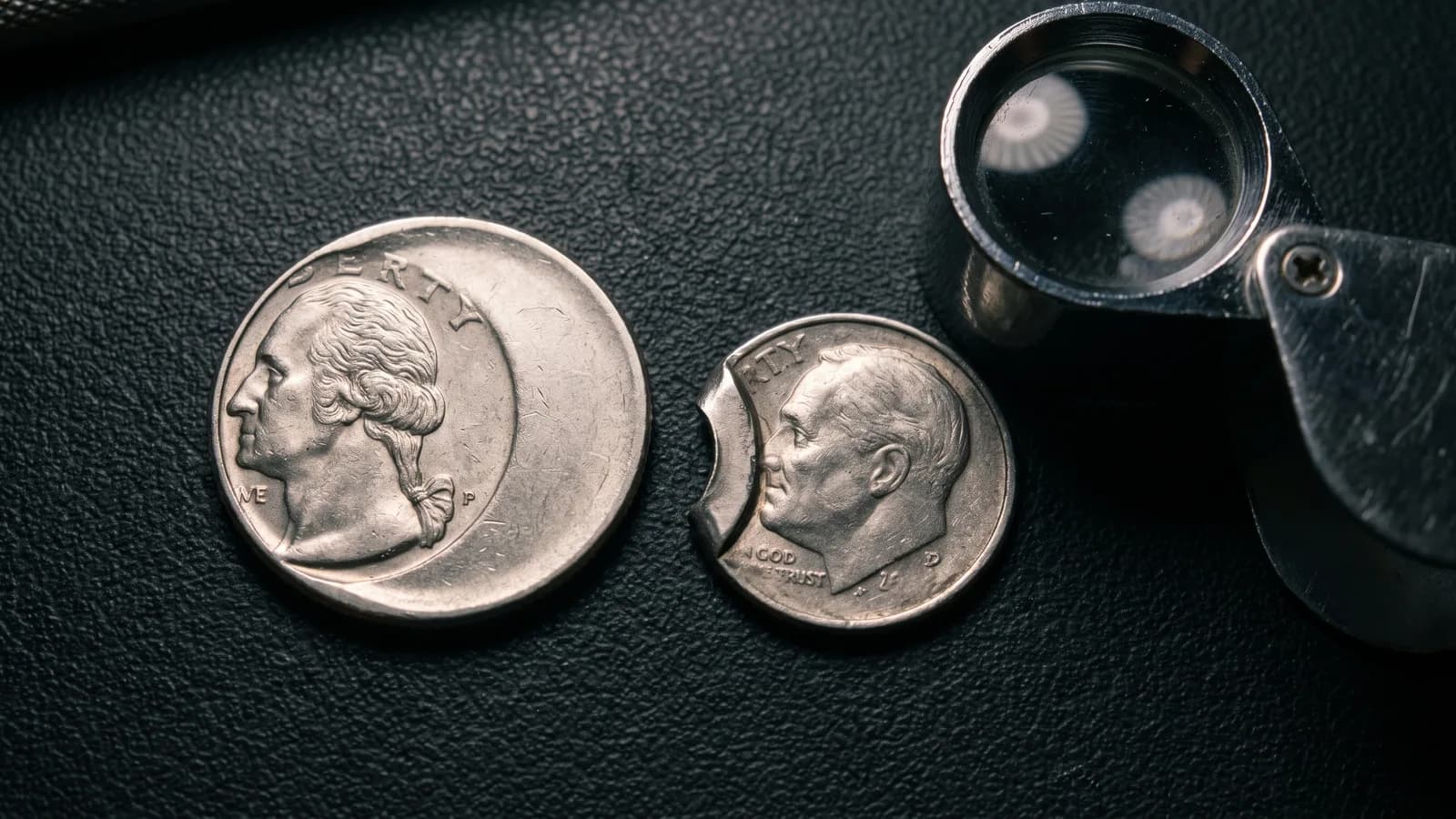
An off-center strike happens when the blank is not centered between the dies, so part of the design is missing and the coin looks lopsided. Value rises with how off-center it is — while still showing a full date — and dramatic examples are popular.
A broadstrike occurs when the retaining collar fails, letting the coin spread wider and flatter than normal. Both are struck-coin errors and are collected for their visual drama.
What are planchet errors?
Planchet errors involve the metal blank (the 'planchet') itself. A clipped planchet is missing a curved or straight piece because the blank was punched incorrectly; a wrong planchet error is a coin struck on a blank meant for a different coin; and a missing clad layer exposes the copper core.
The 1943 copper cent and 1944 steel cent in our 1943 steel penny guide are famous wrong-planchet errors. These can be valuable but are also heavily faked.
What are die errors?
As dies wear, they can crack or break, leaving raised lines or blobs on the coins they strike. A die crack shows as a thin raised line; a cud is a raised blob where a piece of the die broke away at the rim; and a repunched mint mark (RPM) shows a mint mark punched more than once.
Most minor die cracks add little value, but dramatic cuds and well-known RPMs have a following among collectors.
| Error | What it looks like |
|---|---|
| Doubled die | Doubling with notching in date or lettering |
| Off-center strike | Part of the design missing; lopsided coin |
| Clipped planchet | Curved or straight piece missing from the edge |
| Wrong planchet | Coin struck on the wrong blank metal or size |
| Die crack / cud | Raised line or blob from a damaged die |
How much are coin errors worth?
It varies enormously. Minor errors may add a few dollars, while dramatic, well-known errors on popular coins can be worth hundreds or thousands. Three things drive value: how dramatic and visible the error is, how rare that error is, and how popular the coin series is.
Because the range is so wide, compare your coin to documented examples of the same error before assuming a big number, and treat sensational online valuations with caution.
How do you tell an error from damage?
This is the key skill. A genuine error was made at the mint and is part of how the coin was struck; post-mint damage happened afterward and shows tooling marks, dents, or metal pushed in or out. A coin gouged in someone's pocket is damaged, not an error.
If you are unsure, our how to spot fake coins guide covers the warning signs, and a dealer can usually tell at a glance whether something is an error or damage.
How do you authenticate and sell an error coin?
For a potentially valuable error, do not clean the coin and have it authenticated by PCGS or NGC, which attribute major errors. Our guide to which grading companies to trust explains why a recognized holder matters most on errors.
Sell verified errors through a rare coin dealer or a specialist, and use the American Numismatic Association and a local coin shop as resources while you learn.
Frequently asked questions
What is the difference between a coin error and a variety?+
An error is a one-off mistake in making a particular coin or planchet. A variety is a repeatable difference between dies that appears on many coins. Both are collected, but they are valued differently.
How do I know if my coin has a real doubled die?+
A true doubled die shows doubling with notching and separation in the design itself. Flat, shelf-like doubling is usually machine doubling, which is common and adds no value.
Are all coin errors valuable?+
No. Minor errors often add little, while dramatic, rare errors on popular coins can be worth a lot. Value depends on how visible and scarce the error is and how popular the series is.
Is my scratched or dented coin an error?+
Almost certainly not. Scratches, dents, and corrosion are post-mint damage, which carries no premium. A true error is created during minting, not afterward.