
Twenty-Cent Piece Value: America's Most Short-Lived Silver Coin
The twenty-cent piece was a well-intentioned but quickly abandoned denomination, struck only from 1875 to 1878. It was designed to ease making change in the West, where 5-cent pieces were scarce, but public confusion with the quarter — which was the same diameter but had a reeded edge to the twenty-cent piece's plain edge — doomed it within two years. For collectors, the short series is a fascinating challenge: two business-strike years, two proof-only years, and one legendary rarity.
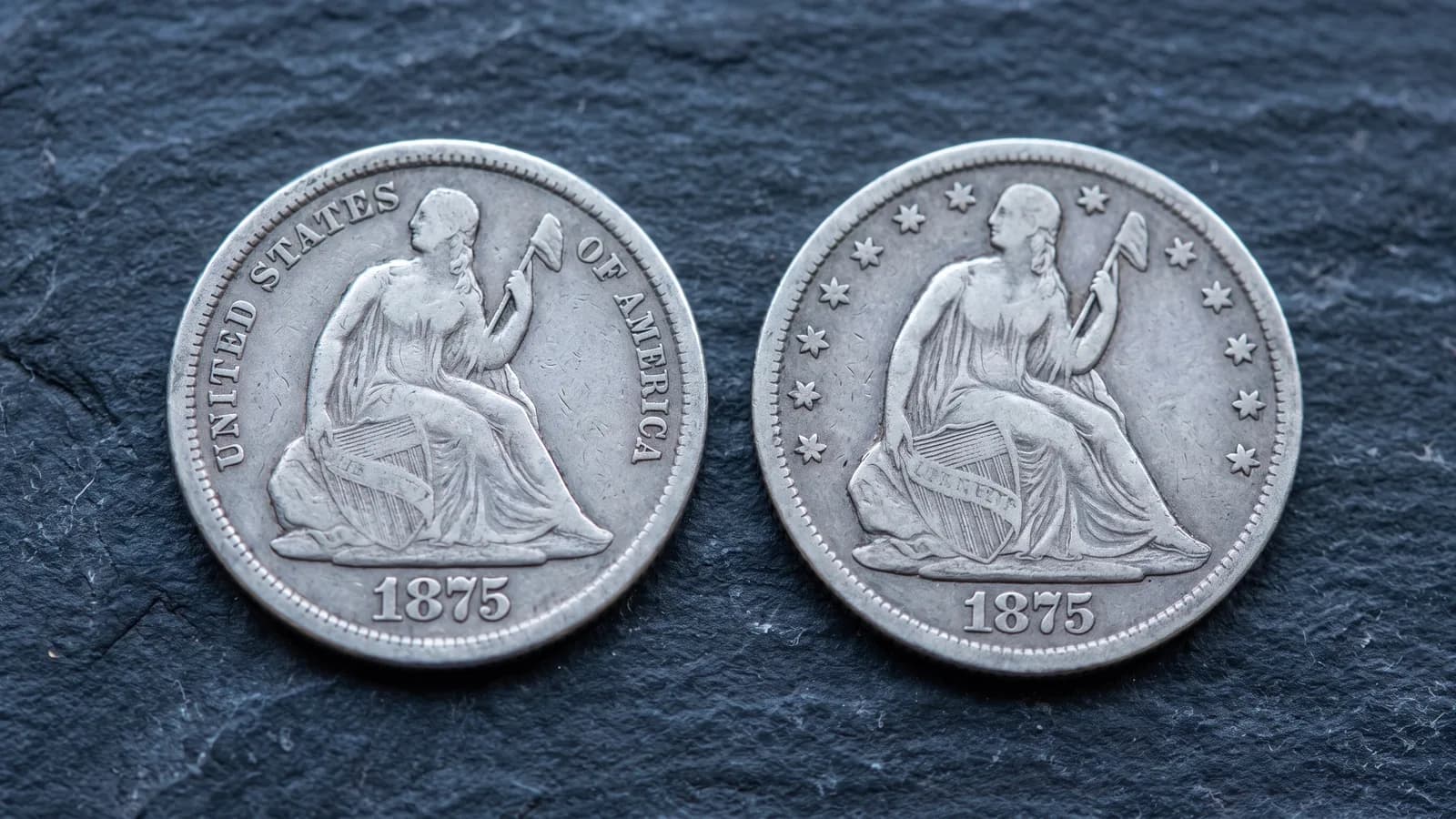
Key takeaways
- The twenty-cent piece was struck from 1875 to 1878 — one of the shortest runs of any U.S. coin series.
- The coin failed largely because it was easily confused with the quarter dollar; its plain (smooth) edge was the only quick visual distinction.
- Business strikes were made in 1875 (Philadelphia, CC, S) and 1876 (Philadelphia, CC); 1877 and 1878 were proof-only years.
- Common circulated 1875-S examples typically sell for $80–$200 in well-worn grades.
- The 1876-CC is one of the rarest regular-issue U.S. coins — only around 10 pieces are known.
Why Was the Twenty-Cent Piece Created?
Nevada Senator John P. Jones proposed the twenty-cent piece in 1875 as a solution for making change in the American West, where silver 5-cent pieces (half dimes) were rarely seen and 25-cent pieces were hard to break. A 20-cent coin, he argued, would let merchants give change for a quarter more easily.
The plan made sense in theory but failed in practice almost immediately. The coin was virtually the same diameter as a quarter dollar (22mm vs. 24.3mm for the quarter), and only the smooth (plain) edge of the twenty-cent piece versus the reeded edge of the quarter distinguished them — a difference invisible in a pocket full of change.
What Are Twenty-Cent Pieces Worth Today?
Common circulated business strikes — primarily 1875-S, which had the largest mintage — sell in Good-to-Fine grades for $80–$175. Very Fine examples bring $150–$300. Extra Fine and Mint State coins start higher. The 1875 Philadelphia and 1875-CC business strikes had lower mintages and command modest premiums over the 1875-S.
All twenty-cent pieces are 90% silver, and silver content is approximately 0.1447 troy ounces per coin. At mid-2020s silver prices, melt value is roughly $4–$5 — entirely below the numismatic value of the most worn circulated example.
Business Strikes: The 1875 and 1876 Issues
The 1875 produced business strikes at all three active mints: Philadelphia, Carson City (CC), and San Francisco (S). The S-mint 1875 is the most common date and the best entry point for new collectors. The CC-mint 1875 is noticeably scarcer. The 1876 had business strikes at Philadelphia only and at Carson City — but the 1876-CC is a different matter entirely (see below).
Genuine 1876 Philadelphia business strikes exist in modest numbers; circulated examples sell for $150–$350 depending on grade.
The 1876-CC: One of the Rarest Regular-Issue U.S. Coins
The 1876-CC twenty-cent piece is extraordinary: while mintage records suggest around 10,000 were struck, the overwhelming majority were melted before release when Congress moved to end the denomination. Only approximately 10 pieces are known today, making the 1876-CC one of the rarest regular-issue coins in the entire U.S. series. Certified examples at auction have brought $100,000 or more.
If you find a coin labeled as an 1876-CC twenty-cent piece at a general sale or in an old collection, do not assume it is genuine — authentication by PCGS or NGC is absolutely required.
Proof-Only 1877 and 1878
Congress effectively ended the twenty-cent piece in 1876, but the Mint continued producing proof examples for collectors in 1877 (approximately 510 proofs) and 1878 (approximately 600 proofs). These are the only known twenty-cent pieces for those dates.
Proof 1877 and 1878 twenty-cent pieces in problem-free condition (no cleaning, original surfaces) command $1,500–$4,000 depending on grade. They are frequently certified and sell well to type and proof set collectors.
Completing the Twenty-Cent Piece Type Set
The complete business-strike set consists of 1875-S, 1875, 1875-CC, and 1876 in circulated grades, plus a proof from 1877 or 1878 to represent the proof-only era. The 1876-CC is omitted by most collectors due to its rarity and cost. This five-coin set (four business strikes plus one proof) is achievable for $600–$2,000 in circulated-to-proof grades. Find accurate examples at coin shows or from local coin dealers specializing in 19th-century issues.
Frequently asked questions
How do I tell a twenty-cent piece from a quarter?+
Run your fingernail along the edge. A twenty-cent piece has a plain (smooth) edge; a quarter has a reeded edge with raised ridges. The quarter is also slightly larger in diameter (24.3mm vs. 22mm).
How much silver is in a twenty-cent piece?+
A twenty-cent piece contains approximately 0.1447 troy ounces of fine silver (90% purity at 5 grams total weight). At mid-2020s silver prices, melt value is $4–$5 — well below any numismatic value.
Are any twenty-cent pieces proof-only?+
Yes. The 1877 and 1878 twenty-cent pieces were struck only as proofs — no business strikes were made in either year. Approximately 510 and 600 examples were struck, respectively.
Why is the 1876-CC so rare?+
Most of the approximately 10,000 1876-CC twenty-cent pieces struck were melted before release when Congress moved to end the denomination. Only around 10 pieces survived, making it one of the rarest regular-issue U.S. coins.
Is the twenty-cent piece a good coin to collect?+
Yes — it is one of the most completable short U.S. series, requiring only four to five business-strike dates plus a proof for a comprehensive collection. The 1876-CC is the only genuinely unobtainable coin in the set for most budgets.