
Gold Dollar Value: What America's Tiniest Gold Coin Is Worth
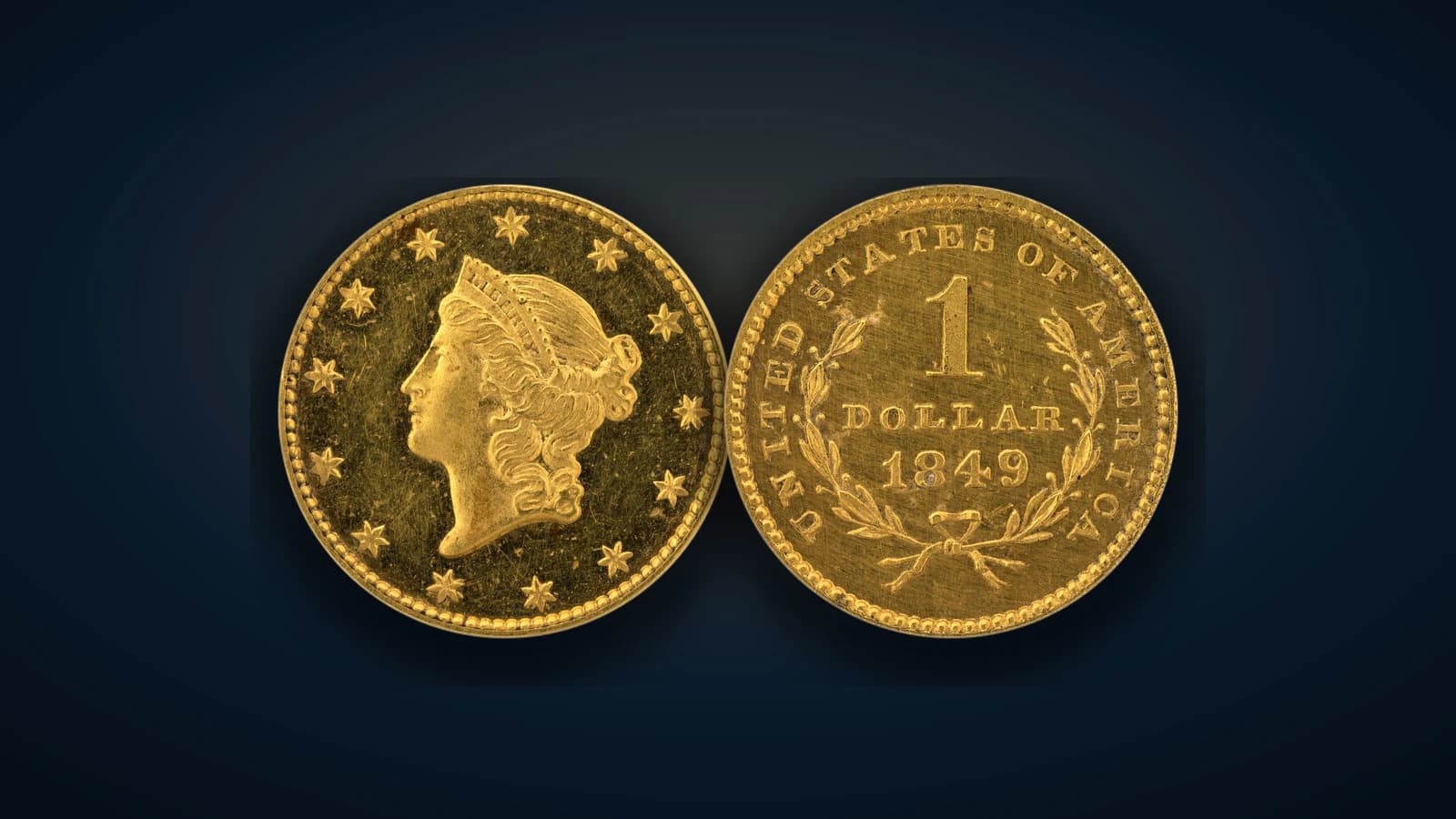
The gold dollar — struck from 1849 to 1889 — is the smallest and lowest-denomination gold coin ever regularly issued by the United States Mint. At just 13–15mm in diameter (smaller than a dime), it contains approximately 0.04837 troy ounces of fine gold. Common-date circulated Type 3 examples trade for $150–$275, just a modest premium above their gold melt value; branch-mint coins, key dates, and the scarce Type 2 command significantly more.
Key takeaways
- Gold dollars (1849–1889) contain approximately 0.04837 troy oz of fine gold, worth roughly $145–$170 at mid-2020s gold prices.
- Three distinct types exist: Type 1 (small head, 1849–1854), Type 2 (large Indian princess, 1854–1856, scarcest), and Type 3 (revised large head, 1856–1889).
- Common-date circulated Type 3 examples typically sell for $150–$275 — just modestly above melt.
- Charlotte (C) and Dahlonega (D) branch-mint gold dollars command significant premiums over Philadelphia coins of the same date.
- The 1875 and 1876 gold dollars were issued only as proofs; no business strikes exist for those years.
Why Was a Gold Dollar Made?
Congress authorized the $1 gold piece in 1849 partly to make use of California Gold Rush metal flooding the market, and partly to create a convenient coin for purchasing 3-cent stamps in small quantities. The denomination was practical in an era when a dollar was substantial, but by the 1880s inflation and the coin's tiny size made it impractical — it was easily lost and mistaken for other coins.
All three gold dollar types were designed by James B. Longacre, the U.S. Mint's chief engraver. The Type 2 redesign in 1854 enlarged the head dramatically to improve legibility; the Type 3 in 1856 refined that enlarged design. The gold dollar was discontinued in 1889 as part of a broader reduction in gold coinage.
The Three Types and What They Are Worth
Type 1 (1849–1854): Small Liberty Head. Common circulated examples sell for $150–$250 in VF-EF grades. Branch-mint issues carry premiums. Type 2 (1854–1856): Large Indian Princess head. This is the scarcest type by far — the oversized head often struck weakly, and many coins are found with poor detail. Problem-free examples in VF condition sell for $250–$600; higher grades are genuinely rare. Type 3 (1856–1889): Revised large head with better proportions. Most affordable and available; common dates in VF to EF grades sell for $150–$275.
Gold content is identical across all three types (0.04837 troy oz), so melt value does not change. Use our gold coin melt calculator for today's exact melt figure.
Branch-Mint Gold Dollars: Charlotte, Dahlonega, New Orleans
Gold dollars struck at the Charlotte (C) and Dahlonega (D) mints — both operating 1838–1861 in the Southeast gold fields — are consistently worth more than Philadelphia pieces of the same date and type. Mintages at these facilities were low, and survivor populations are small. A VF Charlotte or Dahlonega gold dollar commands double to triple the price of the equivalent Philadelphia date.
New Orleans (O) gold dollars are similarly sought but generally less of a premium over Philadelphia. San Francisco (S) issues are available for later dates and carry more modest collector premiums.
Key Dates and Proof-Only Issues
The 1875 and 1876 gold dollars were issued as proofs only — no business strikes were made in either year. Approximately 400 and 1,600 examples were struck, respectively, making the 1875 the rarer of the two. Genuine 1875 proof gold dollars in problem-free condition sell for $2,000–$5,000+ depending on grade.
Among business strikes, the 1849-C Open Wreath (unique?), several Charlotte and Dahlonega issues, and the 1854-D and 1855-C Type 2 coins are significant rarities. Before paying above melt for any specific date or mintmark, verify current certified population data at PCGS or NGC.
Buying and Selling Gold Dollars
Common Type 3 gold dollars are widely available at local coin shops and coin shows. For common dates in circulated grades, a dealer will offer roughly 90–95% of gold melt value (given the modest numismatic premium over melt). For anything beyond common Type 3 Philadelphia dates — branch-mint coins, Type 2, or key dates — buy certified by PCGS or NGC.
The tiny size makes gold dollars especially vulnerable to counterfeiting and to damage from poor storage. Never buy an uncertified gold dollar claiming to be a key date or branch-mint issue without professional authentication. See our pre-1933 gold coins guide for broader context on buying pre-1933 gold.
Frequently asked questions
What is a gold dollar worth today?+
Common-date circulated Type 3 gold dollars typically sell for $150–$275, just above their gold melt value of approximately $145–$170 (0.04837 troy oz at mid-2020s gold prices). Key dates and branch-mint issues are worth much more.
How do I tell the three gold dollar types apart?+
Type 1 has a small, simple Liberty head. Type 2 has a dramatically enlarged Indian Princess head that often shows weak strike detail. Type 3 has a refined, better-proportioned large head with clearer details. A reference photo or loupe makes the difference clear.
Why are Charlotte and Dahlonega gold dollars more valuable?+
Both mints operated only 1838–1861 in Southern gold-producing regions with modest annual output. Low mintages and small surviving populations make their coins genuinely scarce at any grade compared to Philadelphia equivalents.
Are the 1875 and 1876 gold dollars real coins?+
Yes, but proof-only. No business strikes exist for those years. Any 1875 or 1876 gold dollar should show proof characteristics (mirrored fields, sharp rims) and be certified before any significant transaction.
Is the gold dollar a good way to buy gold?+
For a small amount of gold in historic form, yes — common Type 3 examples trade close to melt. But the tiny size and the modest premium over melt make the $10 eagle or $20 double eagle more cost-efficient for gold investors.